
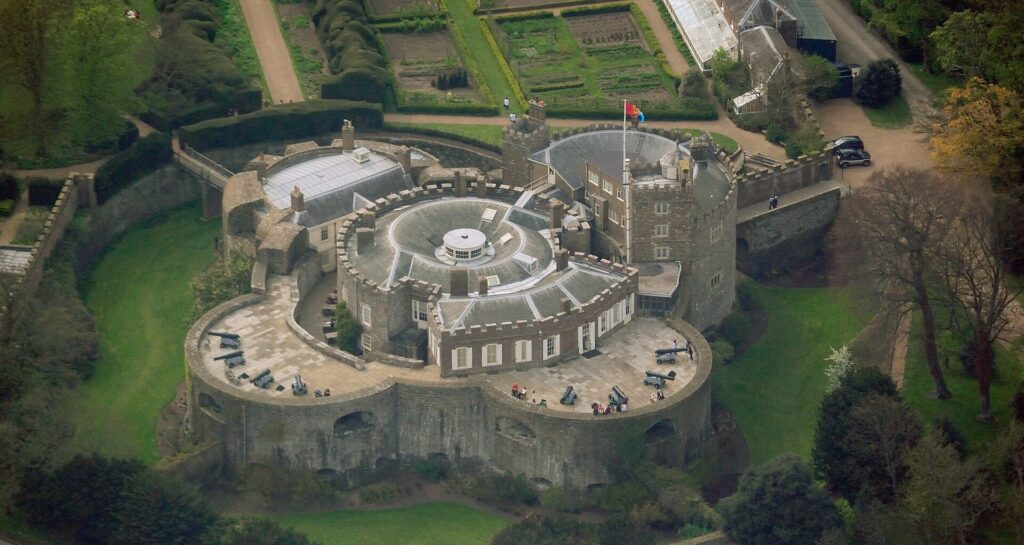
Walmer Castle began as part of Henry VIII’s coastal defences, but its later life brought politicians, military leaders and royal visitors to a very different kind of building. The fort became an official residence, surrounded by gardens shaped by successive occupants.
That combination distinguishes Walmer from a castle presented only through battles. Its story includes defence, public office, domestic life and the changing use of land around a military structure.
A place in the Tudor defence line
The castle was built in 1539–40, alongside related works at Deal and Sandown. English Heritage identifies the three castles as part of a coastal barrier protecting the Kent shore.
Walmer’s compact, rounded form reflects its artillery purpose. It was intended to resist attack and accommodate guns, rather than provide the towering accommodation associated with an earlier medieval keep.
The connection between the castles is important. Their individual plans belonged to a broader response to the risk of invasion, with the sea and nearby beaches determining where protection was needed.
The Lord Warden of the Cinque Ports
From the eighteenth century, Walmer became the official residence of the Lord Warden of the Cinque Ports. The office had developed around the responsibilities and privileges of the ports of the south-east coast.
The original five head ports were Hastings, New Romney, Hythe, Dover and Sandwich. Their wider confederation also included associated towns.
At Walmer, the office brought a new purpose to an existing fort. The building became a place where public status and private occupation met, rather than remaining solely a working coastal defence.
Wellington and other occupants
William Pitt the Younger, the Duke of Wellington and the Queen Mother are among the figures associated with Walmer’s later history.
Wellington died at the castle in 1852. Objects and rooms connected with him form part of the interpretation, allowing the building to be considered through the people who occupied it as well as the circumstances of its construction.
These associations should not make the castle seem unchanged across their lifetimes. Different residents used and adapted the property within the needs and expectations of their own periods.
How the gardens changed the setting
The grounds developed into an important part of the residence. Successive Lords Warden and their households contributed to the landscape, changing the experience of approaching and living at the castle.
A garden can preserve history through layout, planting and the relationship between open space and buildings. It should be read as a designed environment, not simply greenery surrounding the main attraction.
The contrast with the original defensive purpose is particularly revealing: a fort intended to guard a vulnerable coast became the centre of a cultivated retreat.
The Queen Mother’s Garden
The Queen Mother’s Garden adds a more recent chapter. Historic England identifies garden designer Penelope Hobhouse with the project.
Its presence helps visitors understand that Walmer’s landscape was not completed in a single historic period. New design continued to be introduced in response to changing occupants and acts of commemoration.
That makes the grounds a useful complement to the rooms. Both preserve evidence of how later generations worked with a building inherited from a very different age.
Planning a visit with the history in mind
Allow time for the castle and grounds rather than treating the gardens as an optional route to the exit. Each explains a different part of Walmer’s development.
Consult English Heritage for current admission, opening and accessibility information, including any areas affected by seasonal conditions.
The most rewarding question at Walmer is how a coastal fort became a residence. Its history can be followed through defensive architecture, the role of the Lord Warden and the gardens that made a military site into a place of retreat.
Explore our Deal town guide for more local information.
Sources
- English Heritage: Walmer history and stories
- Historic England: Penelope Hobhouse and Walmer
- English Heritage: Walmer visitor information
- Featured image: Walmer Castle aerial view by Lieven Smits. CC BY-SA 3.0. Resized/cropped for website display; the image retains its stated licence. Archive photograph: 16 Apr 2011 14:49 WEST.
