
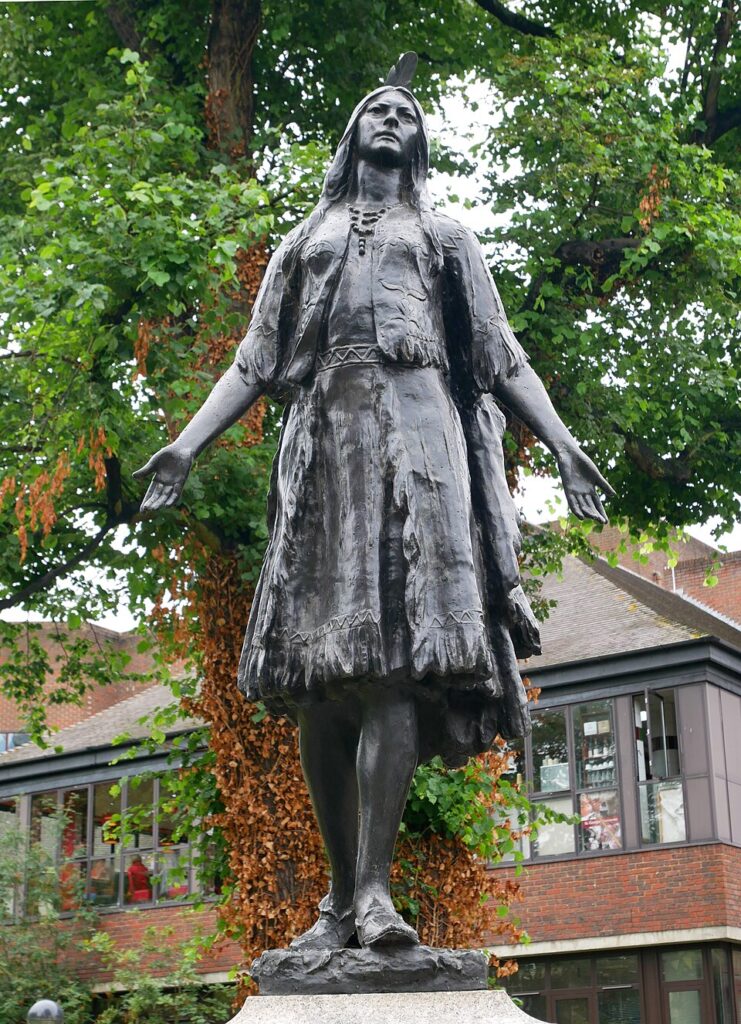
Pocahontas’ connection with Gravesend is a documented part of the town’s history. She died there in March 1617 while beginning a return journey to Virginia, and was buried at St George’s Church.
The statue in the churchyard commemorates that connection. It does not identify a securely known grave: Historic England explains that the original church burned down in 1727 and the exact location of her burial is unknown.
Those facts provide a sound starting point for a story often blurred by popular representations, assumptions and later commemorations.
Who was Pocahontas?
Pocahontas was a Powhatan woman from the region now known as Virginia. She was the daughter of the leader commonly called Powhatan.
The National Park Service and the Smithsonian’s National Museum of the American Indian place her life within the difficult relationship between Indigenous communities and the English colony at Jamestown.
That context matters. Her story should not be reduced to a romantic adventure or treated as though all accounts were written from her own perspective.
The surviving record includes English descriptions and later interpretations. A careful account distinguishes evidence about events from claims about her private thoughts and feelings.
Captivity, marriage and the journey to England
The National Museum of the American Indian records that English colonists abducted Pocahontas in 1613 and held her captive.
She later converted to Christianity, took the name Rebecca and married John Rolfe. The marriage formed part of the relationship between the colony and the Powhatan world, as well as the personal history usually associated with her name.
In 1616, she travelled to England. Historic England connects the visit with the Virginia Company’s efforts to attract investment and settlers.
Her public reception therefore had a political and commercial setting. The journey was not simply an individual sightseeing visit to another country.
Why did she come ashore at Gravesend?
In March 1617, the party began its return journey. Pocahontas became ill and was taken ashore at Gravesend.
Henrico County’s historical account and the National Park Service both connect the town with her final illness and death.
The precise cause of death is uncertain. Some later accounts suggest particular diseases, but those suggestions should not be presented as a confirmed diagnosis.
Gravesend’s location on the Thames helps explain its place in the story. It was a point reached during the departure from London, rather than the intended destination of the transatlantic voyage.
Burial at St George’s Church
The National Park Service records her burial at St George’s on 21 March 1617.
That burial date should be distinguished from a confidently established date of death. Historical summaries sometimes compress separate events into one date.
The church that stood at the time was subsequently destroyed by fire. Historic England says the exact burial position is unknown and that she is thought to lie beneath the rebuilt Georgian church.
Visitors can therefore recognise the church as the place associated with her burial without being shown a proven individual grave.
The distinction does not weaken the town’s historical connection. It makes the evidence and its limits clearer.
What does the statue represent?
Historic England describes the Gravesend statue as a copy of the sculpture at Jamestown.
It was given by the governor of Virginia on the 350th anniversary of her death. The monument is therefore a later act of remembrance, not an image made from direct observation of her life.
Its presence says something about the continuing relationship between Gravesend and Virginia and about the ways different generations have chosen to commemorate her.
In 2017, the statue’s listing was updated as part of the four-hundredth anniversary commemoration.
The history of the monument and the history of Pocahontas are connected, but they should be read as two different layers.
Reading the story with care
Several simple distinctions make an account more reliable.
Pocahontas was a real historical person, while familiar dramatic versions of her story are interpretations. The circumstances of colonial contact included coercion and captivity, not only cultural exchange.
The burial at Gravesend is documented, but its exact position is not known. A statue commemorates a person; it does not automatically mark where that person lies.
Finally, a modern historical article should not invent dialogue or describe emotions as though a reporter had witnessed them.
Reading accounts from the National Museum of the American Indian alongside local heritage records also helps place the Gravesend connection within a larger history.
Visiting the memorial
St George’s Church and churchyard provide the local setting for exploring this connection. Check current church information for access and any arrangements affecting visits.
Approach the memorial as a place of remembrance and historical enquiry. The most interesting questions concern what is documented, how the story reached Gravesend and how later generations represented it.
The town’s connection with Pocahontas is significant enough without embellishment. Its strength lies in the surviving evidence, the acknowledged uncertainties and the opportunity to connect a Kent place with the wider history of colonial America.
More from InKent
Featured photograph: Statue of Pocahontas in Gravesend by Ethan Doyle White, via Wikimedia Commons, CC BY-SA 4.0. Taken 2020-07-08; resized for display. This is an archive photograph.