
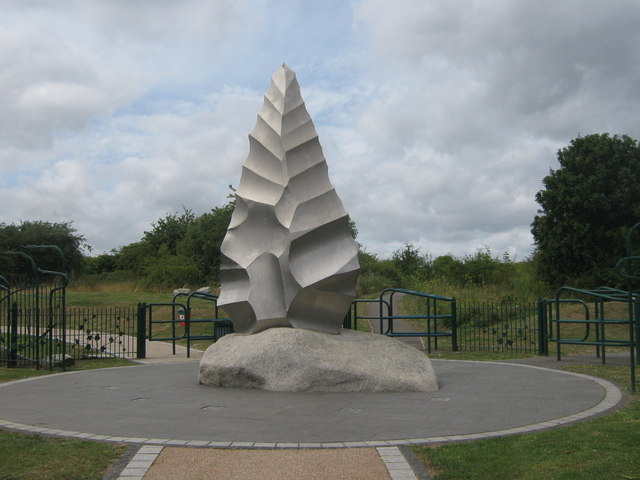
Swanscombe has an important place in the study of early humans because of skull fragments discovered at Barnfield Pit. The remains date to about 400,000 years ago, placing them far beyond the periods usually encountered in a town history.
The site is a National Nature Reserve as well as an archaeological and geological landmark. Its significance comes from the relationship between human remains, tools and the deposits in which they were found.
The first discovery in 1935
Alvan Marston found the first skull fragment on 29 June 1935 while investigating the gravel pit.
The Kent Archaeological Society’s account describes a researcher already interested in the site’s stone tools and deposits. The find therefore belonged within a wider investigation of an ancient landscape.
Commercial extraction and archaeological observation met at the quarry. Material being removed for modern use exposed evidence of a much earlier environment.
Fragments found over time
Three parts of the same skull were discovered separately in 1935, 1936 and 1955.
The sequence matters because the specimen was not recovered as a complete skeleton in one excavation. Understanding it required comparison and continued work.
It also shows why later discoveries can change the meaning of an earlier find. Archaeological knowledge often develops through several investigations rather than a single moment of recognition.
Who did the skull belong to?
The Natural History Museum describes the partial skull as thought to belong to an early Neanderthal woman.
The wording reflects scientific interpretation. An estimate of age and an identification are conclusions drawn from evidence, not information recorded by a contemporary witness.
The traditional label “Swanscombe Man” can therefore be misleading if repeated without explanation. Historical names do not always match the current interpretation of a specimen.
The ancient landscape
The deposits at Swanscombe preserve evidence connected with an earlier course of the Thames and environments occupied by humans and other animals.
Tools and sediments help researchers ask what conditions were like, how people used the landscape and how the remains relate to their surroundings.
A fossil without its context answers fewer questions. Recording where an object was found can be as important as preserving the object itself.
Protecting a place of evidence
National Nature Reserve status recognises the site’s importance within the protected landscape.
The reserve is not an invitation to dig for objects or remove material. Disturbing deposits can destroy the relationships that make evidence useful for research.
Visitors can learn about the discovery through interpretation while respecting the ground that preserves the wider record. The original skull and the place where it was found are different kinds of heritage.
Exploring Swanscombe’s deeper history
Check Natural England and local heritage information for current access, paths and interpretation before visiting.
Do not assume the original skull is displayed at the reserve. Museum collections and outdoor sites have different roles and arrangements, and displays should be confirmed before travelling specifically to see an object.
Swanscombe’s discovery broadens the idea of Kent history. It reaches beyond castles, ports and churches into the long development of human life and the environmental evidence through which that history can be studied.
The strongest account keeps the documented discoveries, scientific interpretation and surviving landscape connected, without inventing details about the individual’s life.
Explore our Swanscombe town guide for more local information.
Sources
- Kent Archaeological Society: discovery account
- Natural History Museum: early Neanderthals
- Natural England: Kent's National Nature Reserves
- Swanscombe Heritage Park: interpretation
- Featured image: Hand Axe Sculpture in Swanscombe Heritage Park by David Anstiss. CC BY-SA 2.0. Resized/cropped for website display; the image retains its stated licence. Archive photograph: 2009-07-22.
