
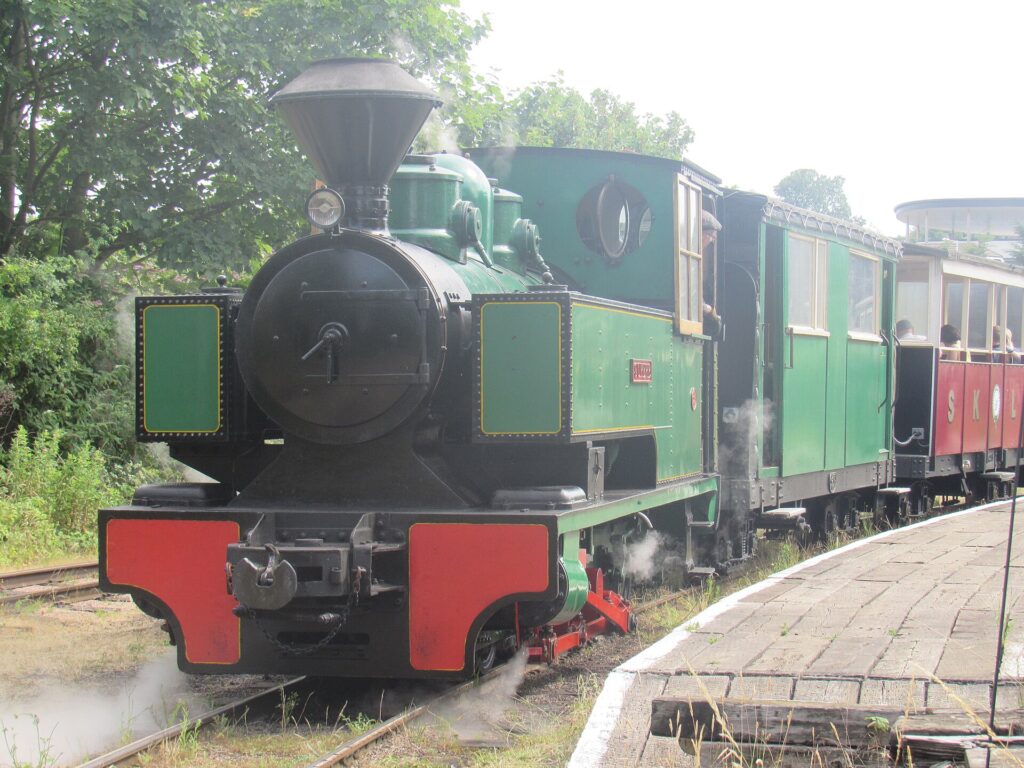
The Sittingbourne and Kemsley Light Railway preserves part of an industrial transport system built around paper production. Its narrow-gauge track and locomotives explain how materials moved through a working landscape before road transport took over much of the task.
A ride is therefore more than a journey behind a historic engine. It offers a route into the factories, waterways and labour that helped shape Sittingbourne.
A railway serving a mill
The railway’s official history connects its origins with Sittingbourne Mill, built by newspaper publisher Edward Lloyd in 1867.
Paper production required large quantities of raw materials and a reliable way to move finished goods. An internal railway could connect storage, production areas and wharves more efficiently than repeated manual handling.
The system began with horse-drawn operation. Its development shows how industrial transport could expand in stages as the needs of a business changed.
Steam arrives
The first steam traction arrived in 1905 with the locomotives Premier and Leader.
These engines were working equipment rather than vehicles designed primarily for public passenger travel. Their size and arrangement reflected the routes and loads of an industrial site.
The railway’s history records a larger fleet during the system’s busiest period. That scale helps explain why the surviving line should be seen as part of a substantial manufacturing operation, not simply a short scenic railway.
Milton Creek and the movement of materials
Water transport was important to the paper mills. Barges brought materials through Milton Creek, linking the factories with wider coastal and river routes.
Rail and water therefore formed parts of a connected system. The railway moved goods through the industrial site, while the creek connected it with places beyond.
Changes in the waterway and the demands of production influenced how that system worked. A railway history becomes more informative when the wharf and creek are considered alongside the locomotives.
The Bowater period
The line became associated with the Bowater paper business. Its name and surviving equipment preserve that connection with the town’s industrial economy.
The railway’s own account describes a later review of internal transport that favoured road movement.
Such decisions were about the operation of a modern business. A railway could remain mechanically capable while no longer fitting the preferred organisation of a factory.
From industrial railway to preservation
In 1969, the railway passed to the group that developed the Sittingbourne and Kemsley Light Railway.
Preservation created a new purpose for part of the former system. Locomotives, track and working knowledge could be retained and demonstrated rather than dispersed or scrapped.
That change also introduced new requirements: passenger safety, maintenance, interpretation and public operation became central alongside the care of historic equipment.
Understanding a visit
Use the railway’s official timetable and visitor information for operating days, fares, accessibility and the starting point for services.
A preserved railway is not necessarily open every day, and maintenance can affect which locomotive is available. Avoid planning around a particular engine without checking.
Look beyond the train itself. The route, surviving structures and relationship with the surrounding industrial landscape help explain why the line was built.
Sittingbourne’s railway is a practical record of how paper reached the wider world. Its value lies in preserving both the machinery and the connections between manufacturing, water transport and the town.
Explore our Sittingbourne town guide for more local information.
Sources
- Sittingbourne and Kemsley Light Railway: official history
- Sittingbourne and Kemsley Light Railway: visitor information
- Historic England: Sittingbourne and Kemsley Light Railway heritage record
- Featured image: Superb awaits to leave Sittingbourne Viaduct Station by Major Midget. CC BY-SA 4.0. Resized/cropped for website display; the image retains its stated licence. Archive photograph: 2017-07-01 16:05:03.
