
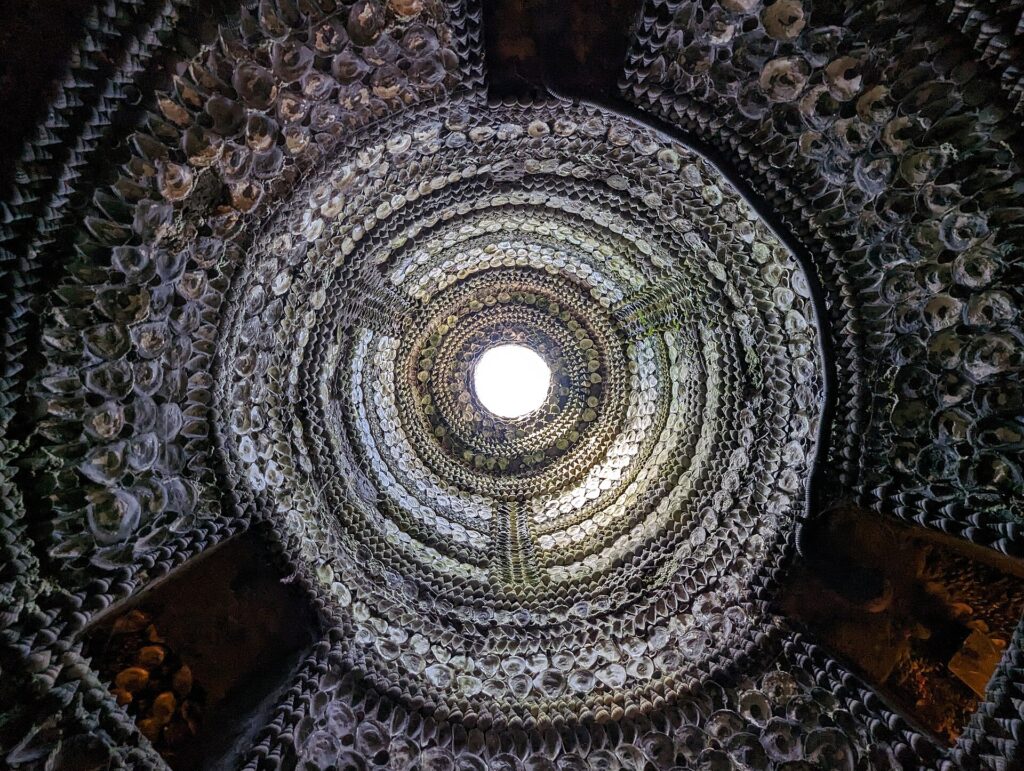
Margate’s Shell Grotto is an underground structure whose walls and ceilings are covered with elaborate shell mosaics. Its discovery in 1835 is documented, but its original date, maker and purpose remain uncertain.
That uncertainty is central to its appeal. A reliable account can explain the remarkable surviving work without turning an attractive theory about its origins into a historical fact.
The discovery and the earlier structure
The Grotto’s official history places its discovery in 1835. Later accounts describe the Newlove family and the circumstances in which the underground spaces became known.
A discovery date is not a construction date. The fact that people encountered the Grotto in the nineteenth century does not, by itself, establish when its passages and decoration were created.
The operator’s archive includes documentary material relating to the discovery and early publicity. That record provides a firmer starting point than stories repeated without a named source.
Millions of shells arranged into patterns
The official visitor account estimates that the decoration contains about 4.6 million shells.
The important feature is their arrangement. Repeated motifs and carefully organised patterns turn ordinary natural materials into a complex decorative environment.
Looking closely reveals choices about shape, colour and repetition. The work can be appreciated as skilled design even when the identity of the designer remains unresolved.
An estimate of the number of shells should be presented as an estimate, rather than as proof that every individual shell has been counted.
Why the purpose remains uncertain
The Grotto has attracted numerous explanations, but the evidence reviewed does not securely identify a single original function.
A suggested interpretation may be interesting without being established. Similar patterns, a resemblance to another site or an appealing symbolic reading cannot replace evidence that directly dates or explains the structure.
The Kent Archaeological Society’s discussion treats the building as an unresolved historical problem. That is a useful model for readers: uncertainty can be acknowledged without dismissing the surviving object.
A protected historic place
The Shell Grotto is Grade I listed. The designation recognises the special interest of the structure; it does not settle every question about its origin.
Protection also draws attention to conservation. Underground decoration must be cared for as physical material, rather than treated only as the setting for a mystery story.
Moisture, lighting and the pressures of access can affect historic surfaces. Following the operator’s instructions helps preserve the detailed work that makes the place significant.
Separating it from other Margate caves
Margate has other underground attractions, but they should not automatically be treated as parts of the same structure.
The archaeological discussion distinguishes the Shell Grotto from separate sites with different construction and location. Similarity in being below ground is not evidence of a shared purpose or date.
When planning a visit, check the exact attraction and address. A photograph of one underground place can otherwise be used to illustrate a different story.
Visiting with curiosity
Use the official website for current opening, admission and access arrangements. The confined underground setting may require particular consideration for visitors with mobility or sensory needs.
Inside, spend time with the patterns as well as the larger rooms and passages. The craftsmanship offers plenty to observe without deciding in advance which origin theory must be correct.
The Grotto’s strongest story is the evidence that survives: a documented nineteenth-century discovery and an extraordinary decorated interior whose earlier history still invites careful investigation.
Explore our Margate town guide for more local information.
Sources
- Shell Grotto: discovery and introduction
- Shell Grotto: tour and shell estimate
- Shell Grotto: discovery archive
- Kent Archaeological Society: archaeological discussion
- Shell Grotto: visiting
- Featured image: Shell-grotto-margate by Alby. CC0. Resized/cropped for website display; the image retains its stated licence. Archive photograph: 2023-03-11.
