
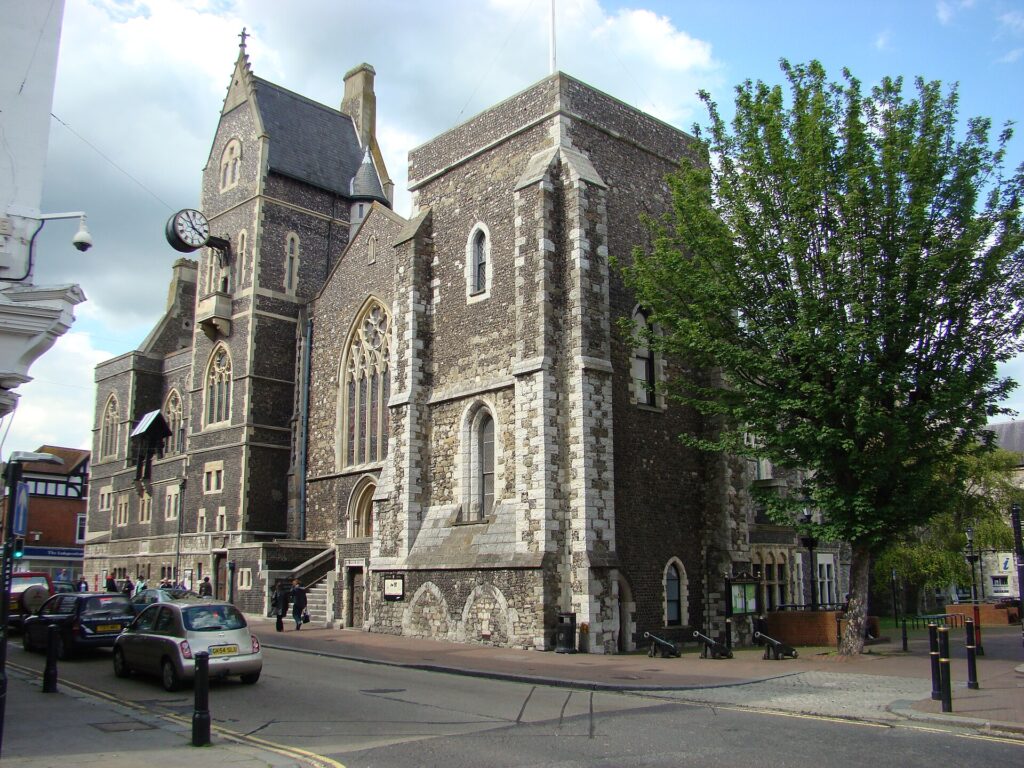
Dover’s Maison Dieu has served travellers, the Royal Navy and the town’s civic life over more than eight centuries. Its name means House of God, but the building’s history reaches well beyond a single religious purpose.
The site began as a hospital for poor pilgrims travelling towards Canterbury. Later uses brought food production, courts, public meetings and elaborate Victorian decoration into the same evolving complex.
A place for pilgrims
The Maison Dieu’s official history places its foundation by Hubert de Burgh at about 1200. It offered overnight food and accommodation to poor pilgrims travelling to the shrine of Thomas Becket.
Dover’s position explains the need. People arriving from the continent could begin their journey inland from the port, and the hospital provided practical support along that route.
The original infirmary does not survive. Documentary research and archaeology are therefore important in reconstructing its early operation, rather than assuming every room seen today belonged to the first hospital.
The surviving medieval hall
The Stone Hall was built in the 1290s. Its scale and architectural treatment reflect a building intended to accommodate significant gatherings as well as routine use.
Royal connections formed part of the site’s history. Dover Castle and the town’s position on the Channel route brought the needs of government and travelling households into the area.
The hall’s survival is particularly valuable because later changes have removed or transformed other parts of the medieval complex. It provides a physical link within a much larger sequence of adaptation.
Supplying the Royal Navy
After the pilgrim hospital’s role ended, the site became a victualling yard. It supplied provisions for naval ships, including biscuit, meat and beer.
The official account describes facilities such as a mill, bakehouse, slaughterhouse and cooperage. These activities connect the Maison Dieu with the practical work required to keep a fleet at sea.
A victualling yard is a reminder that naval history includes food, storage and manufacture. Ships depended on considerable organisation on land before their crews could sail.
From working yard to civic building
The Maison Dieu became Dover’s town hall in the nineteenth century. New civic uses required alterations to historic rooms and the introduction of spaces for courts and public functions.
William Burges contributed to the Victorian transformation, following earlier work by Ambrose Poynter. Decoration, furniture and stained glass helped create a distinctive interior within the inherited building.
This was not a simple return to the medieval appearance. The Victorian designers interpreted the past while adapting the complex to contemporary civic ambitions.
Restoration and the value of craft
The recent restoration brought specialists in masonry, stained glass, painted decoration and other conservation disciplines into the building.
The official project account records work supported by the National Lottery Heritage Fund and project partners, with the town hall reopening in May 2025.
That restoration belongs to the building’s continuing history. Conservators worked with surviving evidence and historic decoration so that the public could understand features obscured or affected by later change.
What to look for on a visit
Consider the building in layers: the pilgrim foundation, medieval hall, naval working site and Victorian town hall. Rooms and objects may explain different parts of that sequence.
The official visitor information is the best source for tours, access and any areas affected by private events. A working venue does not necessarily offer unrestricted access to every room.
The Maison Dieu rewards attention to the people behind its transformations. Pilgrims, victuallers, civic officials, craftspeople and volunteers all belong to its story, showing how one Dover building repeatedly found a new public purpose.
Explore our Dover town guide for more local information.
Sources
- Maison Dieu: official history
- Canterbury Christ Church University: early centuries
- Maison Dieu: visitor information
- Featured image: DoverRathaus by Hajotthu 13:39, 11. Jun. 2009 (CEST). CC BY-SA 3.0. Resized/cropped for website display; the image retains its stated licence. Archive photograph: 2009-05.
