
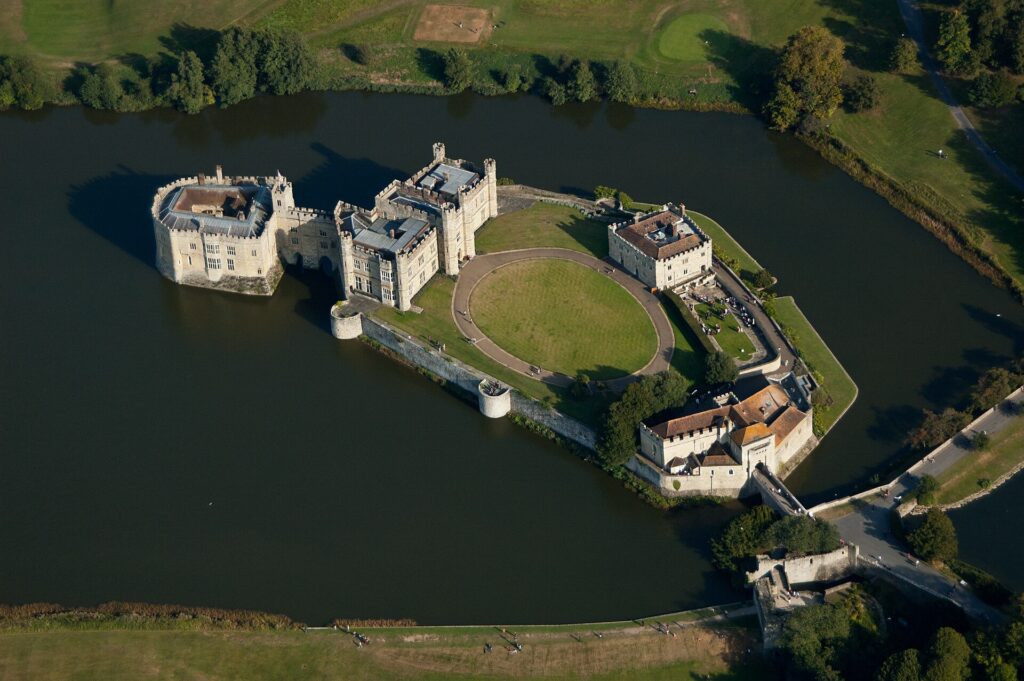
Leeds Castle is in Kent, near Maidstone, rather than in the Yorkshire city of Leeds. Its position on islands in the River Len gives it a distinctive setting, but its history is equally shaped by the people who repeatedly adapted it.
The castle combines medieval origins, royal ownership and a major twentieth-century transformation under Olive, Lady Baillie. Those layers explain why it cannot be understood only as a fortress.
A stone castle on the River Len
The castle’s official history dates the first stone castle to 1119 and associates it with Robert de Crèvecoeur.
The natural setting influenced its form. Building on islands created a relationship between water, approach routes and the arrangement of the castle.
The surviving property developed through later alterations, so the foundation date should not be read as a date for every wall or interior. It marks the beginning of one important stage in a much longer sequence.
The royal connection
Eleanor of Castile acquired Leeds Castle in 1278. The property subsequently became associated with a succession of royal owners and households.
That history explains why comfort, reception and status mattered alongside defence. A royal residence had to support domestic life and the practical operation of a household.
The castle’s own interpretation gives particular attention to women connected with its ownership. Their roles form part of the building’s development, rather than merely supplying names for a list of famous visitors.
A property repeatedly adapted
Leeds Castle changed as the expectations of its occupants changed. Rooms, circulation and decoration could be altered while older structures remained part of the building.
This is a useful way to read a historic interior. Different elements may come from different periods, and a later room can occupy a much older part of the castle.
A visit becomes more informative when the question is not only “How old is this?” but also “What changed here, and why?”
Lady Baillie’s twentieth-century home
Olive, Lady Baillie, and her then husband acquired the castle in 1926. Her later ownership brought extensive changes to the house and estate.
The official history describes furnishing and adaptation that made the castle a prominent twentieth-century residence and setting for entertaining.
These rooms are a substantial part of the site’s history. They should not be dismissed as interruptions to a supposedly pure medieval building, or mistaken for interiors that survived unchanged from the Middle Ages.
Preservation for public benefit
After Lady Baillie’s death, the castle and parkland passed in 1974 to the Leeds Castle Foundation, the charity established through her will.
That transition explains the modern relationship between the historic property and its visitors. Maintaining a castle and landscape requires continuing conservation, management and income.
The visitor attraction is therefore another stage in the life of the estate, rather than the moment at which its history stopped.
Planning a visit
Allow time to understand the water setting as well as the interiors. The relationship between islands, bridges and surrounding grounds is part of the castle’s significance.
Use the official website for admission, opening, accessibility and any separate experiences. Current events or ticket arrangements should not be inferred from an older historical guide.
Leeds Castle rewards attention to the whole sequence: a medieval foundation, a royal residence, a twentieth-century home and a charitable estate preserved for public use. Its appeal lies in the way those different lives remain connected within one Kent landscape.
Explore our Maidstone town guide for more local information.
Sources
- Leeds Castle: official history
- Kent Historic Environment Record: Leeds Castle estate
- Leeds Castle: nine centuries of history
- Featured image: Leeds Castle from the west by Barbara van Cleve. CC BY-SA 3.0. Resized/cropped for website display; the image retains its stated licence. Archive photograph: 2012-09-22 16:07:15.
