
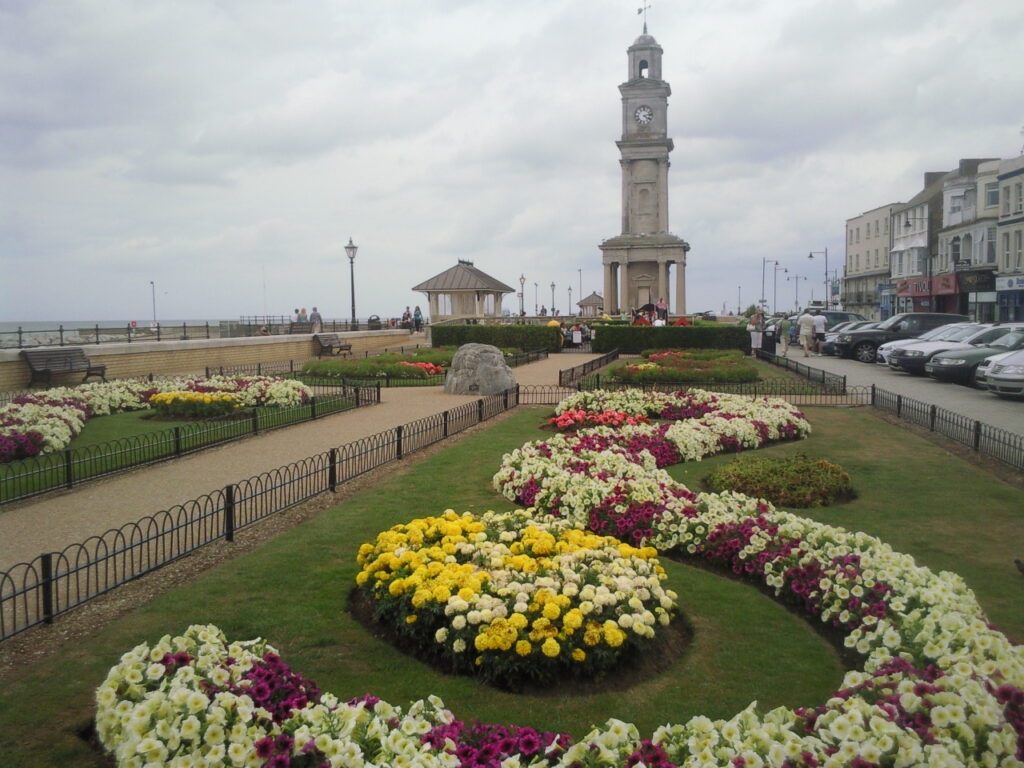
Herne Bay’s Clock Tower stands on Central Parade, where it forms one of the town’s most recognisable seafront landmarks. Built in 1836–37, it belongs to the period in which the resort’s promenade and visitor identity were taking shape.
The tower is Grade II listed. Its importance is best understood through its architecture and position in the town, rather than through unqualified claims that it was the first clock tower of its kind anywhere in the world.
A landmark on the promenade
A freestanding clock tower performs a different public role from a clock attached to a church or town hall. It makes time visible within the everyday space of a street or waterfront.
At Herne Bay, the seafront setting also made the structure a prominent point of orientation. Visitors could recognise a fixed landmark while moving along the promenade.
Its position helps explain its repeated appearance in photographs and local imagery. The tower became part of the way the town presented itself, not simply an instrument serving a practical function.
What the building record tells us
Historic England’s listing identifies the tower on Central Parade and records its construction in 1836–37. The Kent Historic Environment Record provides the corresponding architectural description.
Those records are useful because they anchor the story in a surviving building. They distinguish the structure’s documented date and recognised interest from later publicity or recollection.
Listing recognises special architectural or historic interest. It should not be confused with a guarantee that every feature has remained untouched since construction.
Herne Bay as a developing resort
The clock tower belongs within the wider history of the nineteenth-century seaside town. The council’s town-centre strategy places it among the features that define Herne Bay’s waterfront.
A resort required more than places to stay. Promenades, public landmarks and attractions helped create an environment in which visitors could spend time, meet and find their way.
The tower can therefore be understood as part of a public landscape. Its significance lies partly in the relationship between the building, the open seafront and the streets behind it.
The tower and the pier are separate stories
Herne Bay’s pier is another important part of the waterfront, but it has its own sequence of construction, extension and loss.
Keeping the two histories separate avoids the assumption that all prominent seafront structures were built together or survive in their original form.
Seen alongside one another, the tower and pier illustrate different aspects of resort development: a fixed landmark on the promenade and an attraction extending out over the water.
Looking at the details
A visit can begin with the tower’s overall proportions, then move to the relationship between the clock, openings and architectural decoration.
Compare the building with older photographs in museum or archive collections where available. Such images can reveal changes in the surrounding seafront even when the tower remains a familiar reference point.
That comparison is often more revealing than treating heritage as a collection of isolated dates. A landmark can help make changes in streets, transport and public space visible.
Exploring more of the town
The official cultural trail provides a starting point for connecting the Clock Tower with other places in Herne Bay.
Check current visitor information for museums, events and facilities rather than assuming the historical trail describes what is open on a particular day.
The Clock Tower deserves attention because it connects architecture with the making of a seaside town. It remains a useful point from which to read the waterfront’s changing history.
Explore our Herne Bay town guide for more local information.
Sources
- Historic England: Clock Tower listing
- Kent Historic Environment Record: Clock Tower
- Visit Canterbury: Herne Bay cultural trail
- Canterbury City Council: town-centre strategy
- Featured image: Clock tower at Herne Bay by Marathon . CC BY-SA 2.0. Resized/cropped for website display; the image retains its stated licence. Archive photograph: 2010-07-27.
