
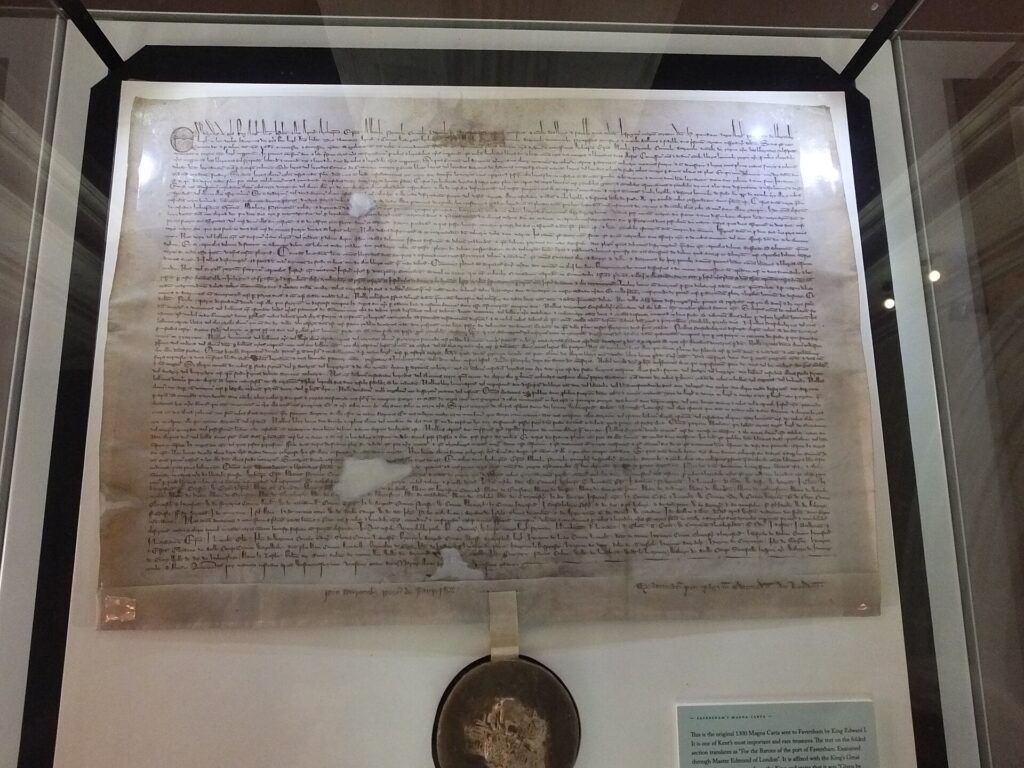
Faversham holds a medieval version of Magna Carta issued in 1300. It is a significant survival within the town’s collection of royal charters and a starting point for understanding the rights, responsibilities and ambitions of a medieval port.
The date matters. Faversham’s document is not one of the surviving charters issued in King John’s reign in 1215. It belongs to the later history of Magna Carta, when confirmation and reissue kept the charter relevant to government and local disputes.
Magna Carta continued after 1215
The first issue is the most familiar episode, but Magna Carta did not remain a single unchanging document.
The National Archives’ educational resources follow later confirmations and the political arguments surrounding them. Those developments help explain why a document issued decades after King John’s reign can still be an important medieval Magna Carta.
A careful introduction therefore separates the charter’s famous origin from the particular object preserved in Faversham. Both dates have meaning, but they answer different questions.
The town’s own copy
Faversham Town Council’s charter exhibition presents the 1300 document alongside other royal charters retained in the town.
Its survival connects a national constitutional story with the practical concerns of a local community. Medieval towns used written grants and confirmations to support privileges and establish their position in dealings with other authorities.
The document is consequently more than an attractive old manuscript. It formed part of the evidence through which a town understood and defended its rights.
Faversham and local power
Research by the Centre for Kent History and Heritage considers the town’s disputes with the abbot of Faversham Abbey and the development of civic organisation.
The researchers place the acquisition of Magna Carta within that context of legal argument and local governance. This is a historical interpretation based on documentary study, rather than proof that one simple motive explains every decision.
The connection is nevertheless useful: major texts could matter locally because communities needed language and evidence for specific conflicts over authority.
A port within the Cinque Ports world
Faversham’s relationship with the Cinque Ports provides another part of the setting. Its port connections linked local trade and obligations with a wider coastal network.
The term “barons” in this context should not automatically be read as a description of titled landowning aristocrats in the modern sense. The language of medieval civic and port communities had particular meanings.
Understanding those terms helps readers avoid imagining a document belonging only to a single noble household, when the town’s collective rights are central to the story.
Reading charters as objects
A medieval charter contains more than its written clauses. Its material, layout and means of authentication form part of the evidence historians study.
An exhibition can help explain those features without requiring every visitor to read the original script. Transcriptions and interpretation allow the content to be connected with the surviving object.
The presence of several charters also encourages comparison. Different documents reveal a continuing relationship between the town and royal authority across more than one reign.
Exploring Faversham’s civic history
Use the official charter exhibition information to check access before travelling specifically to see the document. Historic manuscripts require controlled display and conservation arrangements.
The Guildhall and surrounding historic town centre offer a wider setting in which to consider civic life, trade and the institutions represented by the charters.
Faversham’s Magna Carta matters because it joins a national story to a local one. Its importance is best understood through its own date, its survival and the historical community that preserved it.
Explore our Faversham town guide for more local information.
Sources
- Faversham Town Council: charters exhibition
- Centre for Kent History and Heritage: Magna Carta, Canterbury and Faversham
- The National Archives: Magna Carta, 1259–1306
- Kent Archaeological Society: Faversham's 1300 charter
- Featured image: Magna Carta (Faversham) 9279 by Photograph by Clem Rutter, Rochester, Kent. (www.clemrutter.net).. CC BY-SA 3.0. Resized/cropped for website display; the image retains its stated licence. Archive photograph: 2015-11-26 14:30:43.
