
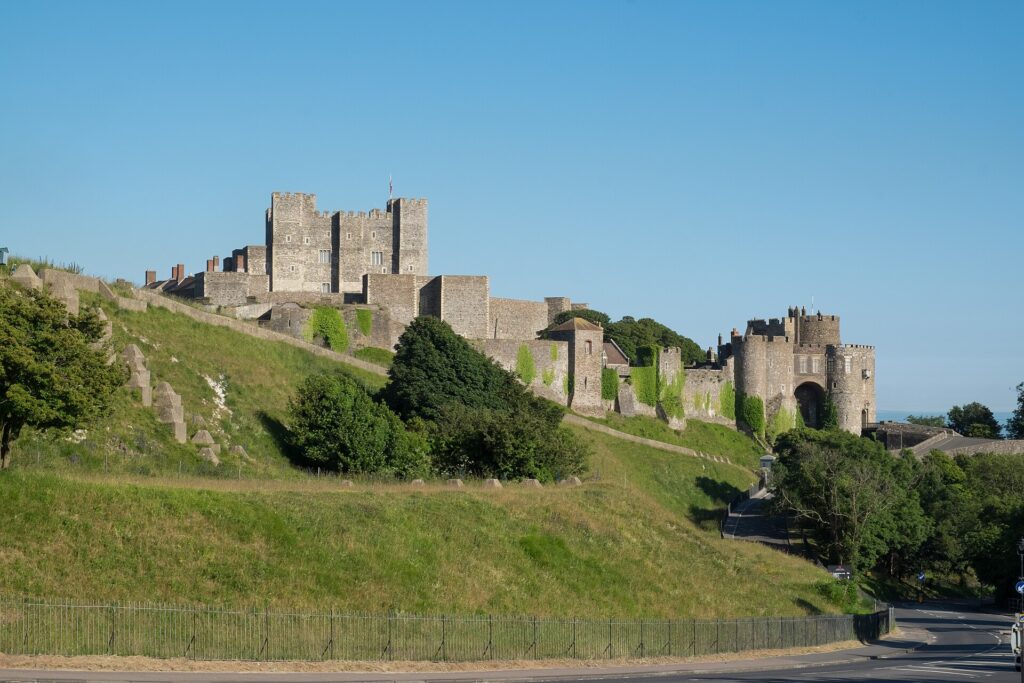
Dover Castle is often introduced as a medieval fortress, but its site preserves a much longer history. A Roman lighthouse, Henry II’s great tower and later military tunnels belong to different periods of a place repeatedly adapted to defend a Channel crossing.
That range makes the castle a useful starting point for understanding Dover. Its importance came from geography as much as architecture: the coast placed it close to routes between England and mainland Europe.
The lighthouse before the castle
The Roman lighthouse is evidence that this hill mattered before the medieval fortress took shape. It stood above the harbour landscape as part of the infrastructure of cross-Channel movement.
Nearby St Mary in Castro adds another layer. The church and lighthouse should not be mistaken for parts of a single medieval building campaign simply because they now stand inside the same visitor site.
Looking at them first changes the order of the story. The castle occupied an already significant place, rather than creating Dover’s connection with maritime travel.
Henry II’s royal project
English Heritage dates Henry II’s major rebuilding to the 1180s. The great tower provided strong defences, but also accommodation suitable for a king and his household.
Its scale expressed royal authority at an important point of entry into England. A visiting court required rooms, food, storage and people to manage daily life, alongside soldiers and defensive works.
This helps explain why a great tower contains more than fighting positions. It combined protection with the practical and ceremonial demands of government.
Siege and further building
Dover’s defences continued to change after Henry II. The castle faced siege in 1216 during the invasion associated with Prince Louis of France and the conflict around King John.
Later work strengthened vulnerable approaches. The site’s history therefore needs to be read as a sequence of responses to changing threats, rather than a complete design finished by one monarch.
Walls, gates and outer works can belong to different campaigns. Their relationship is often more revealing than treating every surviving structure as equally old.
Defending the coast in later centuries
Changes in weapons and military organisation required further adaptation. Dover remained strategically important long after castles had ceased to be the principal form of defence elsewhere.
Tunnels cut into the chalk were developed for military use during the period of conflict with Napoleonic France. They provided a different kind of space from the royal rooms above ground.
The contrast between masonry and underground accommodation shows how the same landscape could support successive approaches to defence without every earlier structure being removed.
The Second World War connection
The tunnels became an important command setting during the Second World War. Dover’s proximity to the Channel made it central to the organisation of the evacuation from Dunkirk in 1940.
English Heritage’s interpretation connects the underground spaces with that operation and with the people working there. It is a separate historical chapter from the medieval siege, even though both involved the same strategic coastline.
A modern visitor can therefore encounter histories measured in centuries and decades within a relatively small area.
Making sense of a visit
Choose the periods you most want to explore before travelling. The great tower, lighthouse and tunnel experiences involve different spaces, and access arrangements can vary.
Use English Heritage’s current information for tickets, opening dates, accessibility and any timed tours. Avoid assuming that an admission ticket means every underground area can be entered at any moment.
Dover Castle rewards a visit organised around change. Its surviving features explain how a place of maritime communication became a royal fortress and then continued to serve new military purposes.
Explore our Dover town guide for more local information.
Sources
- English Heritage: history of Dover Castle
- English Heritage: Dover Castle through time
- English Heritage: visitor information
- Featured image: Dover Castle from the north by DeFacto. CC BY-SA 4.0. Resized/cropped for website display; the image retains its stated licence. Archive photograph: 2018-06-25.
