
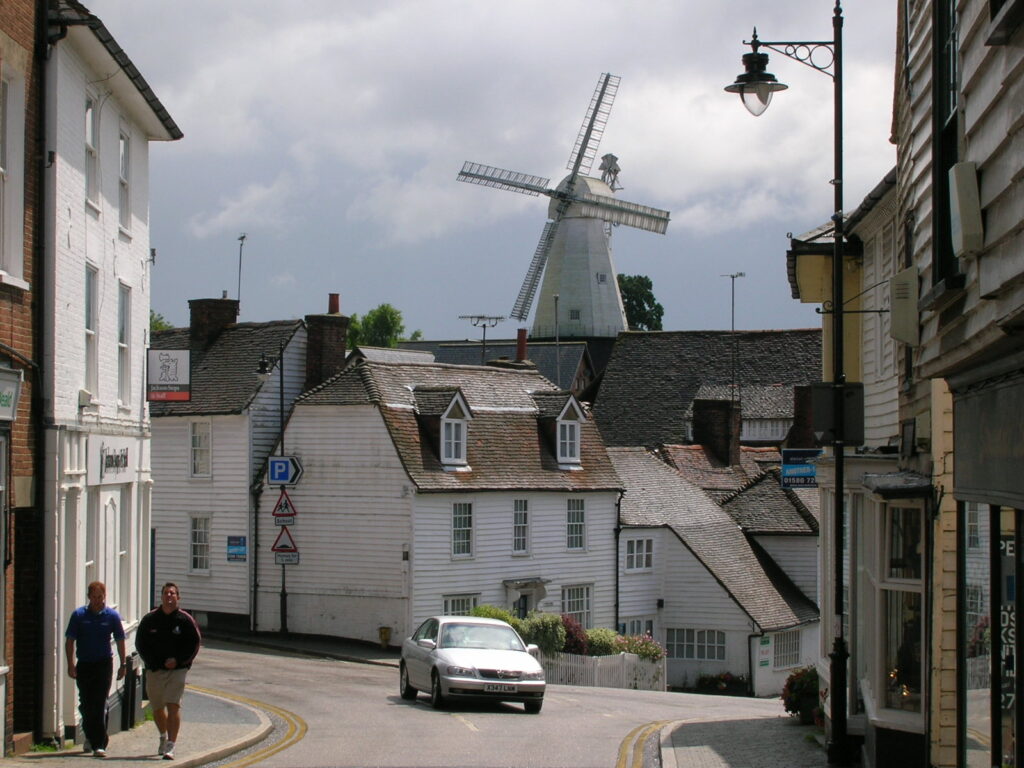
Union Mill rises above Cranbrook as a prominent reminder of the town’s working past. Built in 1814, it is a Grade I listed smock mill whose machinery and structure explain how wind power could support a substantial milling business.
Kent County Council describes it as England’s tallest working smock mill. Its interest goes beyond that distinction: the building allows visitors to connect a familiar landscape feature with the practical stages of food production.
Understanding the structure
The weatherboarded smock tower stands on a tall brick base of three storeys. The fixed body contains the machinery, while the cap can turn to bring the sweeps into the wind.
That arrangement is different from a post mill, in which the main body turns. The distinction helps explain why mills with the same broad purpose can have very different forms.
At Cranbrook, height provided room for the handling of materials and the organisation of the milling process.
Turning wind into work
Kent County Council identifies four patent sweeps driving one of the two remaining pairs of millstones.
The movement outside the building had to be transmitted through shafts and gearing. The resulting power could then be used within a controlled process rather than simply producing rotation.
A mill is therefore a connected system. Changes in wind, the setting of machinery and the condition of working parts all affected what the miller could do.
Why the mill matters to Cranbrook
A large mill served the needs of the surrounding community and economy. Grain had to arrive, be stored and processed, and the resulting flour had to reach customers.
The building is evidence of that network even when the movements themselves have disappeared.
Its position in the town also makes it a useful counterpoint to Cranbrook’s better-known cloth-making history. A place’s economy could include several kinds of production rather than depend on one industry alone.
Preservation and the association
The council records that the mill has been in its care since restoration in 1960. The Cranbrook Windmill Association manages and operates it.
Those responsibilities connect public ownership with specialist and voluntary knowledge. Preserving a mill involves more than protecting its exterior from redevelopment.
Machinery, timber, weather protection and safe interpretation all require continuing attention. A restored working building remains an active conservation commitment.
What exhibits can explain
Models and displays help visitors understand parts that may be difficult to see or follow within the full-sized machinery.
The Science Museum Group also holds a model associated with the Cranbrook mill. Such objects show how technical knowledge can be recorded and communicated at a different scale.
A model is useful evidence about structure and process, but should be distinguished from the complete surviving building. Each offers a different route into understanding how the mill worked.
Planning a visit
Check the council and mill association information for the current season, opening days, demonstrations and access arrangements.
Historic mills can involve narrow stairs and changes of level. Anyone with particular access requirements should seek guidance before planning to explore all floors.
Begin with the relationship between the tall base and the timber tower, then follow how power and materials moved through the interior.
Union Mill is an opportunity to read a town landmark as machinery and workplace. Its scale becomes more meaningful when the practical reasons behind it are understood.
Explore our Cranbrook town guide for more local information.
Sources
- Kent County Council: Union Mill
- Science Museum Group: Cranbrook mill model
- Cranbrook Windmill Association
- Featured image: Union Mill in Cranbrook, Kent by Tony Grist. Public domain. Resized/cropped for website display; the image retains its stated licence. Archive photograph: 2008-06-12.