
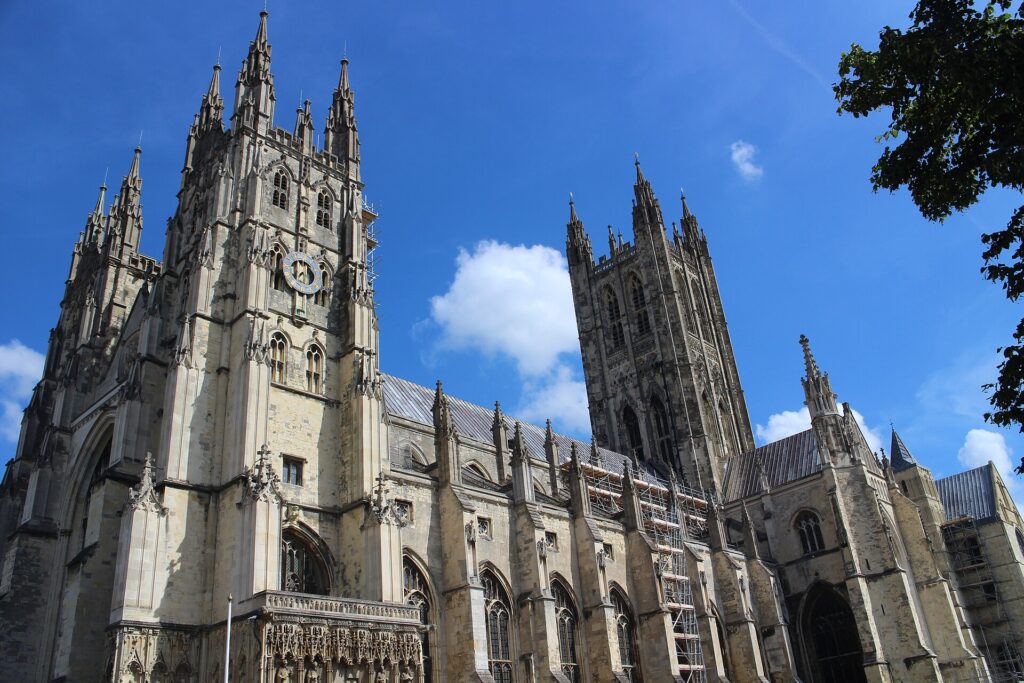
Canterbury’s World Heritage Site includes three separate places: Canterbury Cathedral, St Augustine’s Abbey and St Martin’s Church. Together they explain why this Kent city has a place in the history of Christianity far beyond its size.
UNESCO added the group to the World Heritage List in 1988. The designation concerns a connected historical landscape, rather than the cathedral alone. Seeing the three sites as a group gives visitors a clearer account of how worship, learning and pilgrimage developed here.
St Martin’s: a church before Augustine
St Martin’s represents the earliest part of that story. UNESCO identifies it as a church in continuous use for worship since the sixth century, with Roman fabric surviving within the building.
Its association with Queen Bertha places it within the period before Augustine’s mission arrived in Kent. That matters because the introduction of Christianity was not a simple moment when an entirely unfamiliar religion appeared without any existing connections.
The church’s small scale also makes a useful contrast with the cathedral. Historical importance does not depend on a building being the largest or most elaborate stop on a visit.
Augustine and the abbey
Augustine arrived in 597, and the cathedral dates its foundation to his mission. The abbey outside the city became another major religious institution, associated with the early English church and the burial of its leaders.
English Heritage cares for the abbey ruins. The remains are evidence of a complex that changed over centuries, before the suppression of religious houses during the Reformation transformed its future.
A ruined church needs to be read differently from a building still in use. Foundations, surviving walls and interpretation help explain spaces whose original roofs and furnishings have disappeared.
The cathedral and pilgrimage
Canterbury Cathedral became a major destination for pilgrims following the murder of Archbishop Thomas Becket on 29 December 1170.
The cathedral’s own account places Becket at the centre of its pilgrimage history. His death helps explain why journeys to Canterbury became so important, but the building’s story also includes royal connections, craftsmanship and the continuing work of a religious community.
The cathedral seen today developed through rebuilding and additions. Its foundation date should not be taken to mean every visible wall was standing in the sixth century.
Why UNESCO groups the sites together
Each location preserves a different aspect of a shared history. St Martin’s connects with early worship, the abbey with religious organisation and learning, and the cathedral with an institution that continued to develop.
The value of the group lies partly in those relationships. A visitor moving between them can compare the scale, location and survival of different kinds of religious building.
World Heritage status recognises significance; it does not give every part of the group identical opening hours, ownership or visitor arrangements. Each site has its own practical requirements.
Planning a connected visit
Allow time to walk beyond the cathedral precinct and look at the city between the monuments. The abbey and St Martin’s should be treated as destinations in their own right, rather than optional names on a list.
Check the cathedral, English Heritage and church information before travelling, especially if you want to attend worship or enter a particular building. Services, conservation work and seasonal arrangements can affect access.
The strongest introduction to Canterbury is this combination of places. Its World Heritage story becomes easier to understand when a small church, a ruined abbey and a working cathedral are allowed to explain different parts of the same history.
Explore our Canterbury town guide for more local information.
Sources
- UNESCO: Canterbury World Heritage Site
- Canterbury Cathedral: our story
- English Heritage: St Augustine's Abbey
- Featured image: Canterbury cathedral 20160901 by Suicasmo. CC BY-SA 4.0. Resized/cropped for website display; the image retains its stated licence. Archive photograph: 2016-09-01 19:52:41.
