
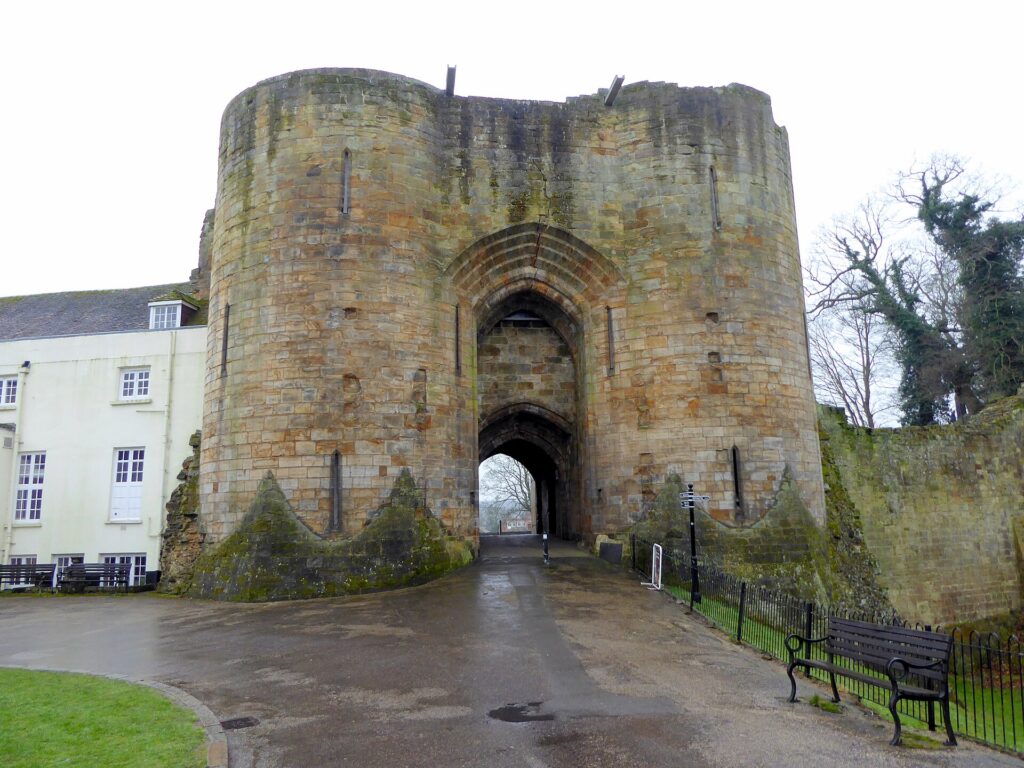
Tonbridge Castle stands beside the River Medway, where its surviving gatehouse and earthworks recall the importance of controlling a crossing. Its history is closely connected with the growth of Tonbridge itself.
The castle is not the same place as Rochester Castle, further down the river. Both help explain the Medway’s strategic importance, but each developed within its own local setting and sequence of ownership.
A Norman beginning
The castle’s official history traces its origins to the period following the Norman Conquest and the de Clare family’s position in the area.
Early motte-and-bailey defences used an earth mound and an enclosed lower area. Stone buildings developed later, replacing or strengthening parts of the earlier arrangement.
This sequence is important because the surviving gatehouse does not date the whole site. A castle could be established in one form and substantially rebuilt in another.
Why the river crossing mattered
A crossing concentrated movement. People, animals and goods needed routes through the landscape, making a nearby stronghold useful for protection and control.
The relationship between the castle and town can still be explored through their positions beside the river.
The Medway was therefore more than scenery. It helped determine where routes met and why an important defensive and administrative centre developed at this location.
The great gatehouse
The twin-towered gatehouse is the castle’s most prominent surviving building. Its thirteenth-century construction belongs to the stone rebuilding associated with the de Clares.
A gatehouse had to manage entry while also providing defensive strength and accommodation. Its function extended beyond being a decorated opening in a wall.
The building’s arrangement helps explain the combination of authority and practical control. Anyone entering the castle passed through a carefully organised and protected point.
A complex with missing parts
The surviving structure represents only part of the original castle. Earthworks and the open area around the gatehouse need to be considered alongside masonry that still stands.
A visitor can otherwise mistake the most complete building for the entire institution.
Historic plans, archaeological study and the official interpretation help reconstruct the relationship between the motte, enclosure and later buildings. Missing walls and rooms are part of the story of alteration and loss.
From lordship to public place
The castle’s official account follows its changing ownership and eventual role as a place belonging to the people of Tonbridge.
The grounds became part of the town’s public life. That transition adds a civic chapter to a site originally associated with the power of a lordly household.
The castle’s modern use should therefore be seen as another stage in its history, rather than a neutral setting outside the historical narrative.
Exploring the castle and town together
Start with the gatehouse, then look towards the river and the surrounding streets. The relationship between those places explains why the site mattered.
Check the castle’s current information for interior access, tours, events and accessibility. The arrangements for the grounds and the historic building may differ.
Tonbridge Historical Society’s accounts provide further context for connecting the castle with the town’s development.
The most useful visit joins architecture with landscape. The gatehouse is impressive in itself, but becomes more informative when placed within the history of the crossing and the community that grew around it.
Explore our Tonbridge town guide for more local information.
Sources
- Tonbridge Castle: official history
- Tonbridge Historical Society: castle
- Tonbridge Historical Society: town history
- Kent Historic Environment Record
- Featured image: Tonbridge Castle, Gatehouse by PAUL FARMER . CC BY-SA 2.0. Resized/cropped for website display; the image retains its stated licence. Archive photograph: 2018-02-19.
