
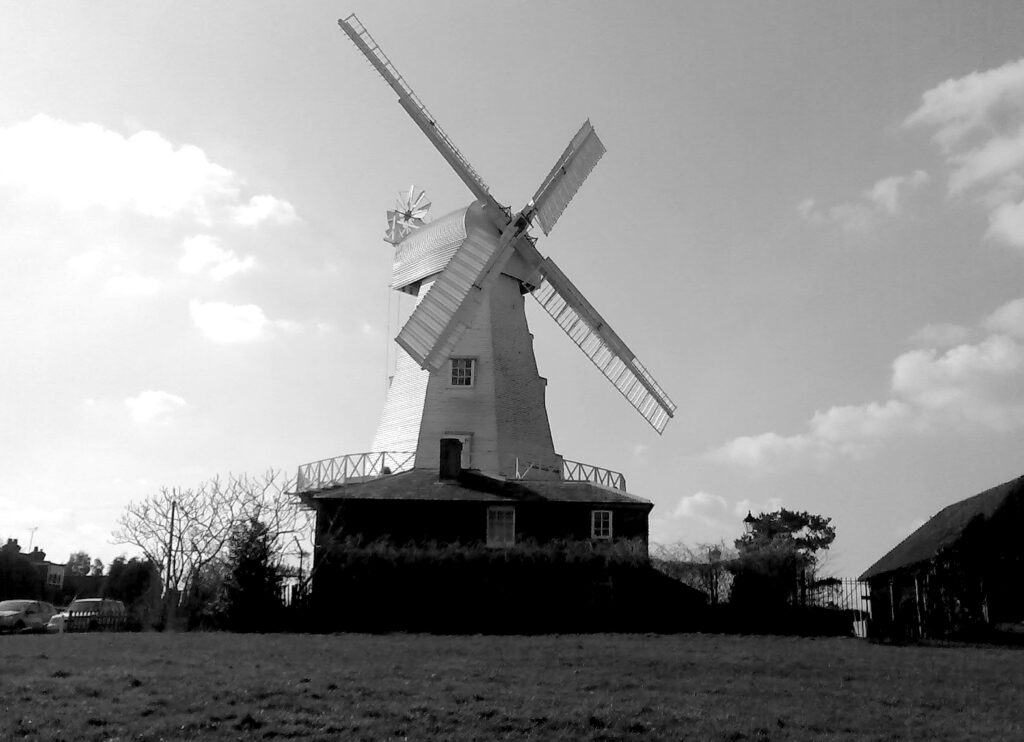
Willesborough Windmill is a white smock mill on a red-brick base, built in 1869. It preserves part of Ashford’s working history: the machinery, buildings and skills involved in turning grain into flour.
The mill’s later restoration is also important. Its survival reflects a decision to preserve an industrial building and make its operation understandable, rather than allowing it to disappear after its original commercial role declined.
What is a smock mill?
A smock mill has a fixed, tapering tower, usually clad in weatherboarding, with a cap that turns so the sails can face the wind.
At Willesborough, that timber structure stands above a substantial brick base. The arrangement provided space for machinery and the stages through which grain and flour moved.
The shape is therefore functional. Looking beyond the picturesque exterior reveals a building organised around power, handling materials and the work of the miller.
A relatively late windmill
The 1869 date places Willesborough within the later history of British wind-powered milling.
It was built in a period when industrial technology and transport were changing rapidly. A windmill of this date was not simply an unchanged survival from medieval life.
The Mills Archive’s technical account identifies the work of local millwrights and describes a sophisticated installation. That context helps visitors see engineering and adaptation rather than a generic image of an old rural craft.
Machinery and the miller’s work
Wind energy had to be transferred through machinery to perform useful tasks. Gearing, shafts and millstones connected the movement outside with work inside the building.
The miller also had to manage grain, flour and changing operating conditions. The job involved judgement and maintenance, not merely waiting for the wind to turn the sails.
Interpretation at a working or restored mill can make those relationships visible. A stationary machine can still explain a process, while a demonstration helps show how its parts interact.
The mill and its associated buildings
Ashford Museum’s heritage account identifies an attached miller’s cottage as part of the setting.
That domestic connection is important. Industrial work was not always separated from home life by the journey to a distant factory.
The wider buildings help explain how a milling business occupied a place: machinery, storage and accommodation belonged within the same working environment.
Restoration and preservation
The heritage account records restoration in 1991 through Ashford Borough Council, following the mill’s deterioration.
The Friends of Willesborough Windmill have an important role in its continuing operation and interpretation. Such work depends on practical skills as well as fundraising and public interest.
Restoration should be understood as a substantial modern chapter. The building survives as heritage because people chose to repair, maintain and explain it.
Visiting with the machinery in mind
Use the mill’s official website for current opening, tours and access information. A historic mill may contain steep stairs, restricted spaces and machinery that cannot be approached freely.
Do not assume the sails will be turning whenever the site opens. Operating conditions and maintenance requirements affect demonstrations.
Begin with the exterior form, then follow the explanation of how grain moved through the building. The most useful question is how each floor and mechanism contributed to the finished product.
Willesborough Windmill offers a distinctive way to explore Ashford: through the local engineering, food production and voluntary effort embodied in a working landmark.
Explore our Ashford town guide for more local information.
Sources
- Ashford Museum: Willesborough Windmill
- Mills Archive: technical account
- Willesborough Windmill: official information
- Featured image: Willesborough Windmill 1 by andie_fairlie. CC BY 2.0. Resized/cropped for website display; the image retains its stated licence. Archive photograph: 2008-04-16 16:41.