
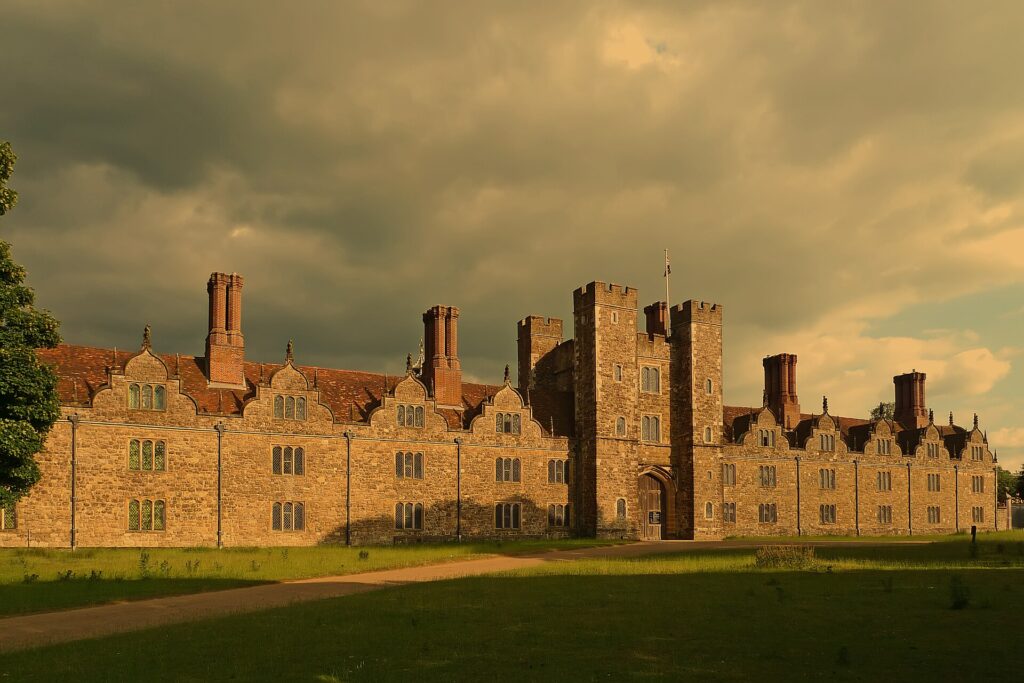
Knole combines a vast historic house with a deer-park landscape beside Sevenoaks. Its history connects archbishops, the Crown and the Sackville family, while its rooms and collections reveal how a major household changed over centuries.
The setting is also a place of continuing ownership and management. The National Trust cares for the visitor property, while the Sackville family’s Knole Estate has an important role in the wider park.
An archbishop’s great house
Thomas Bourchier, Archbishop of Canterbury, acquired Knole in 1456. The National Trust identifies him with the development of much of the great house and its surrounding estate.
The building’s scale reflects more than domestic comfort. A senior churchman required accommodation for guests, household members and administration, alongside spaces that expressed status.
Courtyards and ranges help explain that organisation. Knole was an institution-sized home whose daily operation depended on many people working beyond its principal rooms.
Royal possession and the Sackvilles
The house later passed into royal hands before becoming associated with the Sackville family.
That sequence matters because the building was inherited and adapted by successive owners. Its appearance cannot be assigned entirely to one individual or one brief period.
The family connection also continues beyond the historic displays. Knole is not simply a house whose domestic life ended at the moment it became a visitor attraction.
The collections and the rooms
Knole’s furnishings, paintings and objects are central to understanding the interiors. They show how rooms were arranged to receive, display and accommodate as well as to shelter.
A large historic collection can include objects made in different periods and acquired through different routes. The relationship between an object and a room needs interpretation, rather than an assumption that everything was created together.
The National Trust’s historical account also draws attention to people who lived and worked at Knole. Their experiences broaden a story that might otherwise focus only on prominent owners.
The park and its deer
The park preserves an important historic landscape with a long connection to deer.
Its ownership is more complex than a general statement that the National Trust owns everything visible around the house. Official visitor information distinguishes land managed by the Trust from the wider Knole Estate.
Visitors should follow current routes and instructions, keep an appropriate distance from deer and avoid feeding or approaching them. A managed historic herd is still composed of animals whose behaviour should be respected.
A place recorded through changing evidence
The estate’s own history, the National Trust’s interpretation and Kent’s Historic Environment Record provide complementary accounts.
Together they connect documentary events with the surviving house and landscape. Dates of acquisition explain ownership, while building phases and collections explain what owners did with the place.
That combination is more useful than a list of famous residents alone. It reveals how authority, inheritance and practical management shaped the property.
Making time for Knole
Decide whether your priority is the house, collections or park, then check the official arrangements for each.
Access to particular interiors, parking and routes may have separate conditions. Use the National Trust and estate information rather than assume the entire landscape operates as one unrestricted attraction.
Knole’s appeal lies in these connected histories: a great house built for influence, a family institution repeatedly adapted and a landscape whose management continues around it.
Explore our Sevenoaks town guide for more local information.
Sources
- National Trust: history of Knole
- Knole Estate: history
- National Trust: park information
- Kent Historic Environment Record: Knole Park
- Featured image: Knole House, Sevenoaks, Kent by John Wilder. CC BY-SA 3.0. Resized/cropped for website display; the image retains its stated licence. Archive photograph: 2009-06-21 18:15:41.
