
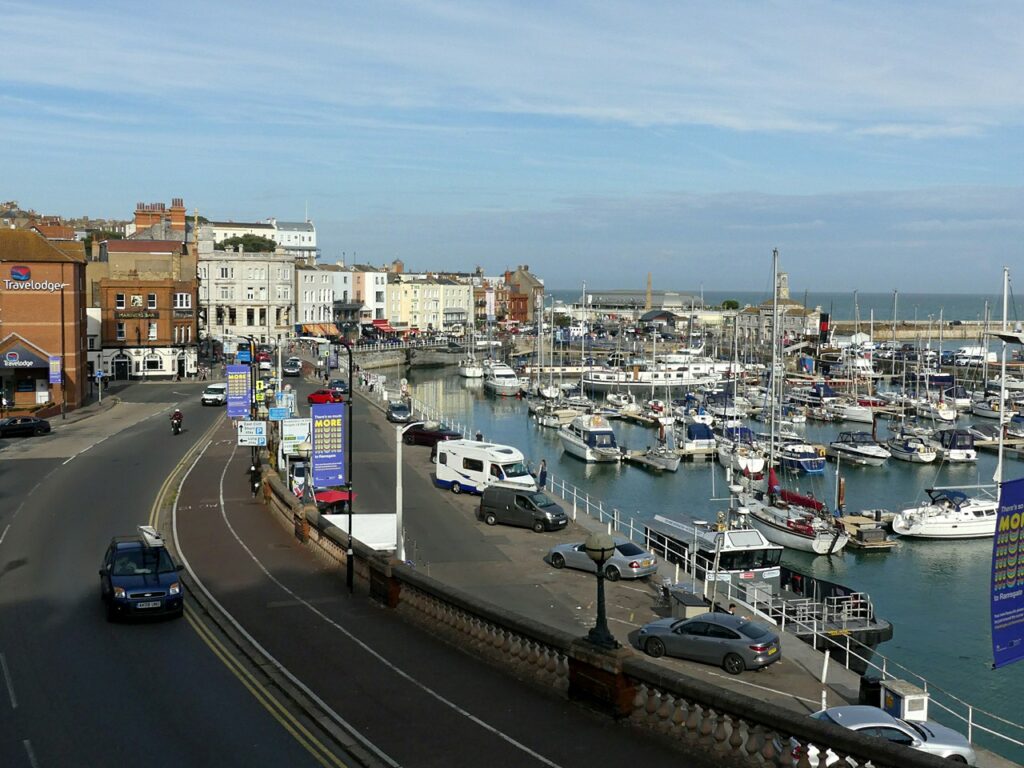
Ramsgate’s Royal Harbour is one of Kent’s defining coastal places. Its title is associated with George IV, but its history also includes major engineering works, maritime trade and the demands of war.
The harbour helped shape the town that developed around it. Its piers, basins and waterfront buildings are evidence of a working port as well as a setting enjoyed by modern visitors.
A harbour built in stages
Construction of the harbour began in the eighteenth century. Kent’s Historic Environment Record describes a sequence of work on the east and west piers, inner basin, crosswall and other facilities.
Engineers including John Smeaton and members of the Rennie family contributed to later development.
This sequence matters because the harbour was not a single finished object delivered in one year. Repairs, extensions and alterations responded to changing vessels, trade and practical experience of the coast.
The royal connection
George IV’s association with Ramsgate led to the Royal Harbour designation in 1821.
The title gives the place a distinctive public identity, but it should be understood within its historical context. Royal patronage added status to a harbour that already had a working purpose and an established relationship with the town.
A useful history therefore combines the royal episode with the less glamorous engineering and daily labour that allowed the port to function.
Reading the engineering
Piers protect an entrance and help create usable water, while basins and associated structures organise vessels and port activity.
The historic record identifies repeated modifications to Ramsgate’s works. Those changes show that coastal engineering involves adjustment over time, rather than a design remaining successful without maintenance.
Walking around the harbour can make these relationships visible. The experience is different when a quay or wall is considered as infrastructure serving boats, cargo and people, rather than simply as the edge of a view.
The harbour in wartime
Ramsgate played a role in national events, including the Napoleonic period and the two world wars.
The heritage record identifies its connection with the Dover Patrol during the First World War and its role in receiving people brought back from Dunkirk in 1940.
Those events are separate chapters. The harbour’s wartime significance should not be reduced to one dramatic episode or illustrated with an unrelated photograph.
How the harbour shaped the town
The growth of a port creates demand for work, housing, services and transport. Ramsgate’s harbour also contributed to its development as a seaside destination.
That combination helps explain the character of the waterfront: maritime infrastructure sits beside places designed for hospitality, residence and public life.
Modern leisure uses form another stage in that history. They do not erase the port’s working responsibilities or make every operational area a space for unrestricted public access.
Exploring responsibly
Use official harbour and visitor information for current access, events and facilities. Take care around quays, moving vehicles and areas used by boats and port staff.
A history-focused visit can begin with the piers and basin, then look back towards the streets and buildings that developed around them.
Ramsgate’s Royal Harbour is most rewarding when the title is treated as an introduction rather than the whole story. Its lasting significance comes from the relationship between engineering, royal patronage, working maritime life and the growth of the town.
Explore our Ramsgate town guide for more local information.
Sources
- Visit Ramsgate: town history
- Kent Historic Environment Record: Royal Harbour
- National Historic Ships: Ramsgate Royal Harbour report
- Featured image: Ramsgate Harbour by Alan Murray-Rust . CC BY-SA 2.0. Resized/cropped for website display; the image retains its stated licence. Archive photograph: 2022-09-03.
