
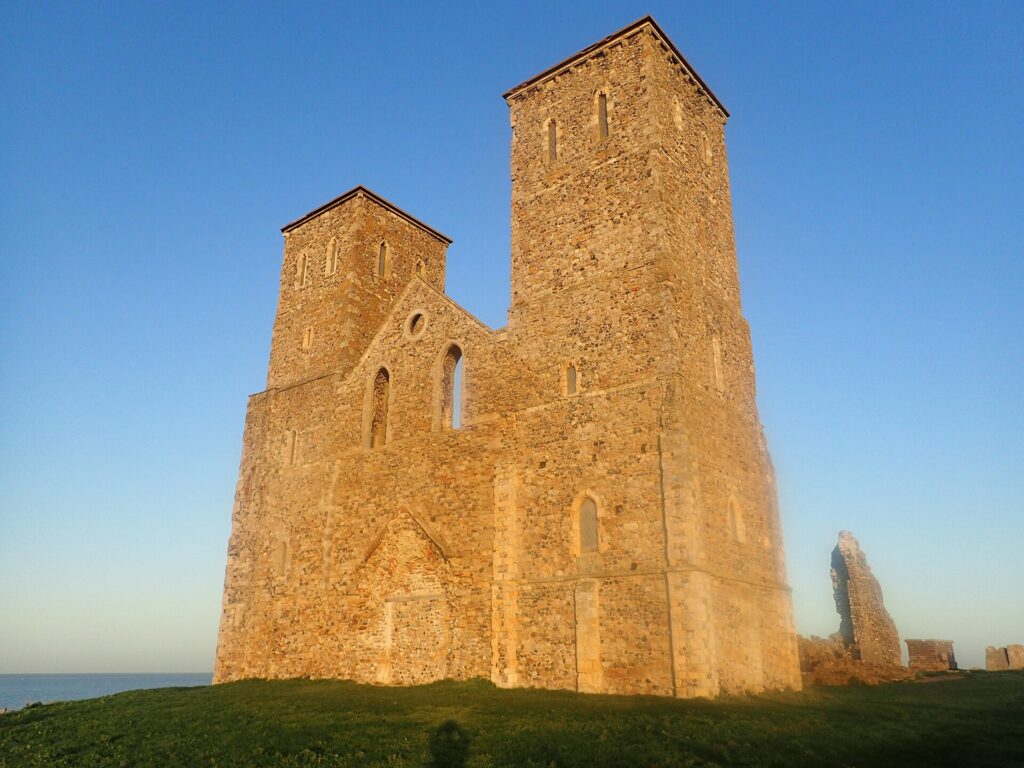
Reculver’s twin towers are among the most recognisable landmarks on the north Kent coast. They belong to a medieval church, but the ground beneath them preserves a much older history of Roman defence and an Anglo-Saxon religious community.
The site also records a changing coastline. Understanding the sea’s movement is essential: the remains seen today occupy only part of a place that once had a very different relationship with the surrounding land and water.
A fort beside the Wantsum Channel
English Heritage dates the substantial Roman fort to the early third century AD. It guarded the northern end of the Wantsum Channel, the waterway that separated the Isle of Thanet from mainland Kent.
Richborough occupied an important position towards the channel’s other end. Considering the two sites together helps explain a landscape organised around water routes that no longer exist in their ancient form.
The channel later silted up. A map of modern roads and fields therefore needs to be supplemented by the historical geography before the purpose of the fort becomes clear.
More than the surviving walls
Substantial portions of Roman masonry remain, but coastal erosion has removed about half of the fort site, according to English Heritage.
What survives is consequently an incomplete record. Missing buildings or walls do not prove that the lost areas were empty; in some cases, the evidence has simply been destroyed.
The relationship between archaeology and erosion is particularly visible here. The coast preserves a dramatic setting while also explaining why parts of the historical site can no longer be investigated in their original position.
A monastery inside the fort
A religious community was established within the former Roman enclosure in the seventh century. The foundation associated with 669 introduced a new purpose into a landscape already shaped by military construction.
Reusing a fortified site connected the monastery with surviving buildings, materials and boundaries. It also illustrates how Roman places could remain significant after the end of Roman government.
The monastery’s story belongs to the wider development of Christianity in Kent, alongside better-known sites in Canterbury. Reculver provides a coastal perspective on that history.
The towers and parish church
The prominent towers date from the twelfth century. They should not be confused with the date of the earlier monastery or the construction of the Roman fort.
The church later served the parish after the monastic community ceased to function. Religious buildings frequently acquired new roles without a completely new structure being created.
Much of the church was subsequently dismantled, while the towers survived. Their visibility made them useful as a navigation marker for shipping, giving the remains a continuing practical relationship with the sea.
Why conservation matters here
English Heritage’s conservation account describes the continuing challenge of caring for a site exposed to coastal conditions.
Preserving the towers is not only a matter of keeping an attractive silhouette. The masonry carries evidence of construction, alteration and loss, while the wider remains connect several historical periods.
The surrounding country park has its own management and facilities. Visitors should distinguish the care of the historic monument from the operation of nearby paths, cafés and other services.
Exploring the site today
Start by looking at the relationship between the towers, sea defences and surviving Roman walls. Then use the interpretation to place the church within the earlier enclosure.
Check current access and coastal-path information before travelling, especially after poor weather. Keep to available routes and respect barriers around vulnerable remains.
Reculver offers more than a striking photograph. Its value lies in the combination of Roman engineering, medieval worship and the physical evidence of a coastline that has continued to change.
Explore our Herne Bay town guide for more local information.
Sources
- English Heritage: Reculver history
- Canterbury City Council: Reculver conservation appraisal
- English Heritage: conservation and changing tides
- Featured image: Reculver Towers by Marathon . CC BY-SA 2.0. Resized/cropped for website display; the image retains its stated licence. Archive photograph: 2022-11-25.
