
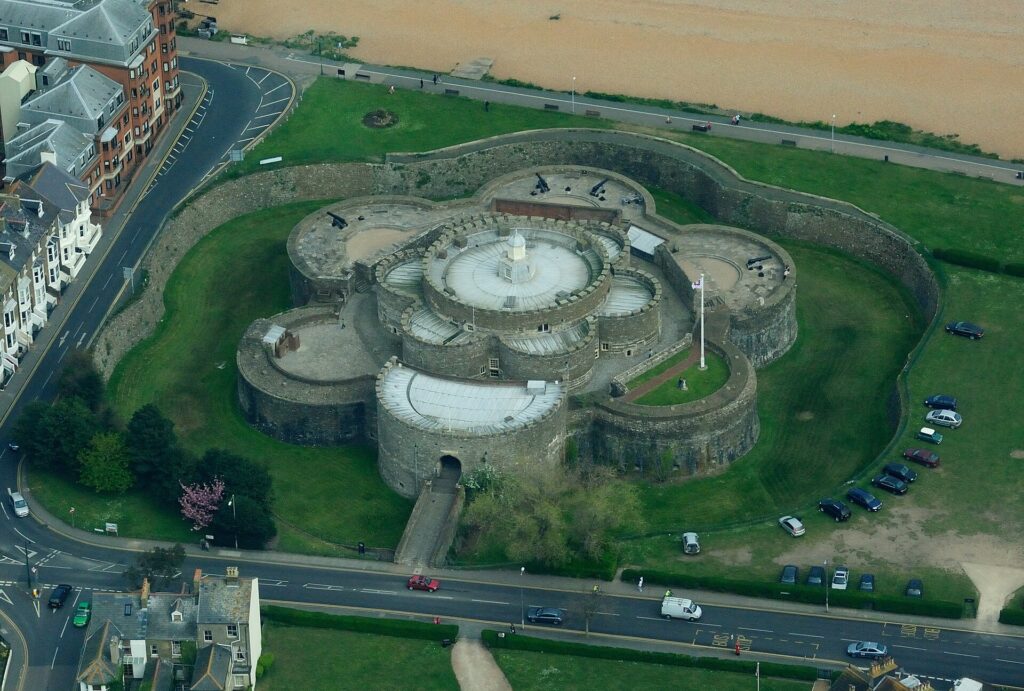
Deal Castle is a Tudor artillery fort on the Kent coast, built in 1539–40 during Henry VIII’s programme of coastal defence. Its rounded plan is a practical answer to a military problem: how to bring guns to bear against an approaching enemy.
The castle makes more sense when considered alongside the sea. It defended the Downs, the important anchorage sheltered by the Goodwin Sands, and formed part of a wider line of coastal works.
Why the king needed coastal forts
Henry VIII’s foreign policy created a threat of invasion from continental Europe. The response included new defences around stretches of the southern and eastern coast.
Deal belonged to a group with Walmer to the south and Sandown to the north. These were related installations, intended to cover vulnerable beaches and the anchorage rather than stand as isolated inland strongholds.
Their location shows the connection between maritime trade, naval movement and national defence. Protecting ships at anchor also meant considering where an enemy might land troops.
A shape built around guns
English Heritage describes Deal as an artillery fortress designed for extensive, all-round firepower. Its projecting rounded bastions provided positions from which guns could cover several directions.
That is a different starting point from the tall, dominant keep associated with an earlier medieval castle. Lower and broader works responded to the growing importance of gunpowder weapons.
The familiar comparison with a flower can help someone recognise the outline, but the military arrangement is the more useful explanation. The plan organised firing positions, movement and protection.
An unfinished castle receives a royal visitor
Anne of Cleves landed at Deal on 27 December 1539 while travelling to meet Henry VIII. English Heritage records that she rested at the castle while construction was still incomplete.
The episode places a major national story within a specific Kent setting. It also provides a reminder that buildings can enter public life before every part of a construction programme is finished.
Deal was already functioning within the king’s coastal world, even while the new defensive complex was taking shape.
The Civil War brings a different threat
In 1648 the castle endured a siege during the English Civil Wars. Royalist and Parliamentarian forces were fighting over a fortress originally built to resist an enemy arriving from overseas.
That change illustrates a recurring feature of military buildings: their usefulness can outlast the political circumstances that produced them.
The castle’s position and defensive capacity remained important, even though the immediate conflict involved competing forces within the country.
From fortress to residence
Deal’s history continued after its principal military role declined. English Heritage describes alterations from the eighteenth century that made it more suitable as a residence.
The change did not erase its Tudor form. Instead, domestic use developed within a structure whose basic plan had been designed for artillery.
This mixture is worth looking for on a visit. A castle is often the result of successive occupants finding new uses for inherited rooms and walls, rather than one unchanging military machine.
Reading the castle today
Begin with the relationship between the fort, beach and sea, then consider how the bastions fit around its centre. The outline is easier to understand when viewed as a series of connected gun positions.
Inside, use the interpretation to distinguish original defensive spaces from later alterations. Rooms used for living and rooms intended for storage or fighting need not belong to the same stage.
Check English Heritage’s current opening and access information before travelling. Deal Castle’s lasting interest lies in that combination of distinctive design, coastal purpose and a history that continued long after Henry VIII’s reign.
Explore our Deal town guide for more local information.
Sources
- English Heritage: Deal Castle history
- English Heritage: Deal Castle stories
- Kent Historic Environment Record: artillery castle at Deal
- Featured image: Deal Castle Aerial View by Lieven Smits. CC BY-SA 3.0. Resized/cropped for website display; the image retains its stated licence. Archive photograph: 16 Apr 2011 14:48 WEST.
