
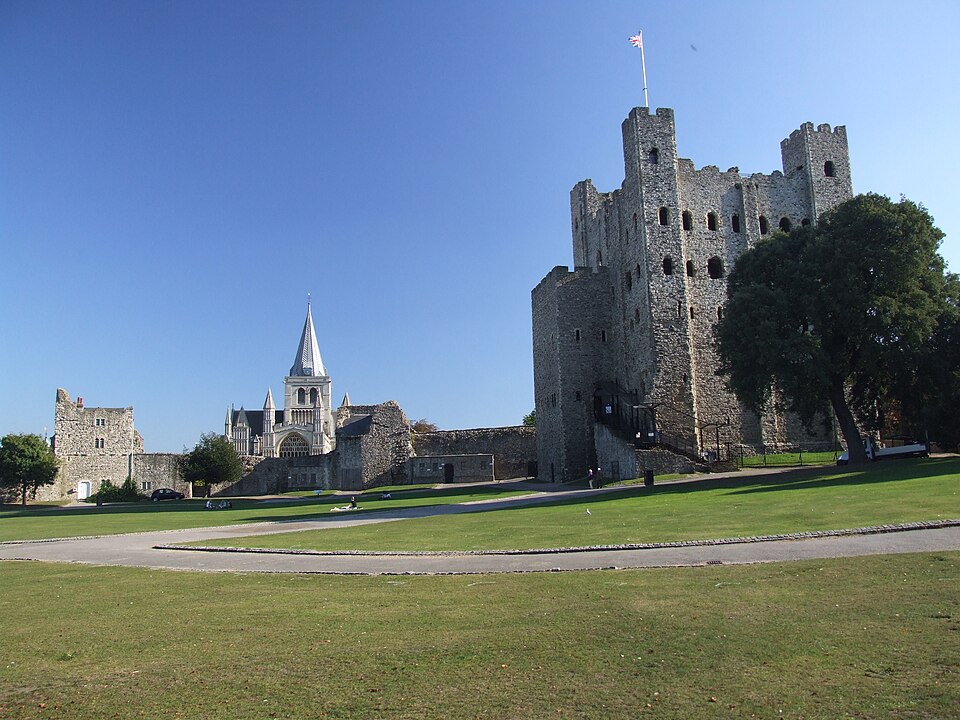
Rochester Castle’s great keep is one of Kent’s most recognisable medieval buildings. Its position beside the Medway crossing explains why it mattered, while the siege of 1215 explains some of the damage and rebuilding still associated with it.
The castle was more than a defensive tower. It occupied a strategic place on the route linking London with Canterbury and Dover, giving control of the river crossing particular importance.
Understanding that setting helps turn the familiar silhouette into a story about movement, authority and conflict in medieval England.
Why build a castle at Rochester?
The river crossing made Rochester a place worth controlling. A bridge concentrates travel at a particular point, and a nearby stronghold can protect or threaten that route.
English Heritage traces the castle’s origins to the period after the Norman Conquest. Early defences were later rebuilt in stone under Gundulf, Bishop of Rochester.
The site therefore developed over time. The surviving keep should not be treated as a building that appeared complete immediately after 1066.
Kent’s Historic Environment Record connects the castle with the route between London and the Channel coast, reinforcing the importance of its location.
When was the keep built?
In 1127, Henry I entrusted the castle to William de Corbeil, Archbishop of Canterbury, with a requirement to build fortifications.
The great keep followed. It combined defensive strength with accommodation and the practical requirements of a high-status residence.
A keep is often imagined only as a last refuge during an attack. At Rochester, its scale also speaks to authority and the resources available to those responsible for it.
Visitors can consider the building’s internal spaces as well as its walls. Rooms, openings and circulation reveal that a castle had to be inhabited and supplied, not merely withstand missiles.
What happened in 1215?
King John’s siege took place during conflict with rebel barons. English Heritage places the attack between October and December 1215.
The royal forces captured the outer area and attacked the keep. Bombardment was accompanied by mining beneath the south-east corner.
The aim of undermining was to remove support from the masonry. English Heritage’s account describes timber props being burned, bringing down the corner and forcing defenders into the remaining part of the building.
The defenders eventually surrendered after food ran short. That sequence shows why a siege involved supplies and endurance as well as direct assault.
The often-repeated detail about the fat of forty pigs comes from the historical account presented by English Heritage. It should be understood as a sourced description of the operation, rather than a decorative legend added to make the story more dramatic.
Reading the evidence in the building
The keep’s different corner forms are a visible clue to its history. The south-east corner was rebuilt with a rounded turret after the original square corner was destroyed.
A surviving building rarely represents just one moment. Repairs, alterations and losses can reveal successive periods of use.
That is particularly useful at Rochester, where the architecture allows visitors to connect a written account of the siege with a physical change.
It does not mean that every stone can be assigned confidently to a particular day’s fighting. A useful visit combines visible evidence with the interpretation provided by the site’s historians.
The castle after King John
The castle’s story continued after 1215. Henry III’s reign brought repairs and additional accommodation in the outer enclosure.
Further conflict in 1264 damaged buildings in the bailey. English Heritage describes a long period of decline following the destruction of the royal hall and chambers.
These later events help explain why the surviving monument is uneven. Some elements remained useful and were maintained; others were damaged, altered or lost.
The keep’s survival should not obscure the larger complex that once surrounded it. Looking across the grounds can help visitors imagine the relationship between the central tower, the outer defences and buildings that no longer stand.
Visiting Rochester Castle with the history in mind
Start with the landscape. The Medway, bridge and nearby streets explain the castle’s strategic position before any individual architectural feature is considered.
Then look for the contrast between the keep’s corners and the relationship between the tower and the surrounding enclosure.
Use current official visitor information for opening arrangements, admission and accessibility. Historic towers can involve steps and uneven surfaces, so a general description of the monument should not substitute for access guidance.
The castle also makes a useful starting point for exploring Rochester’s wider heritage, including the cathedral and High Street.
Its strongest story is not simply that a medieval building survived. It is that the surviving structure preserves evidence of decisions, conflict and repair across several centuries.
The siege of 1215 is the best-known episode, but Rochester Castle becomes more interesting when that dramatic event is placed within the longer life of the town and its river crossing.
More from InKent
Featured photograph: Rochester Castle keep and bailey, with the cathedral in the background by Clem Rutter, Rochester, Kent, via Wikimedia Commons, CC BY 3.0. Taken 2011-09-29; resized for display. This is an archive photograph.