
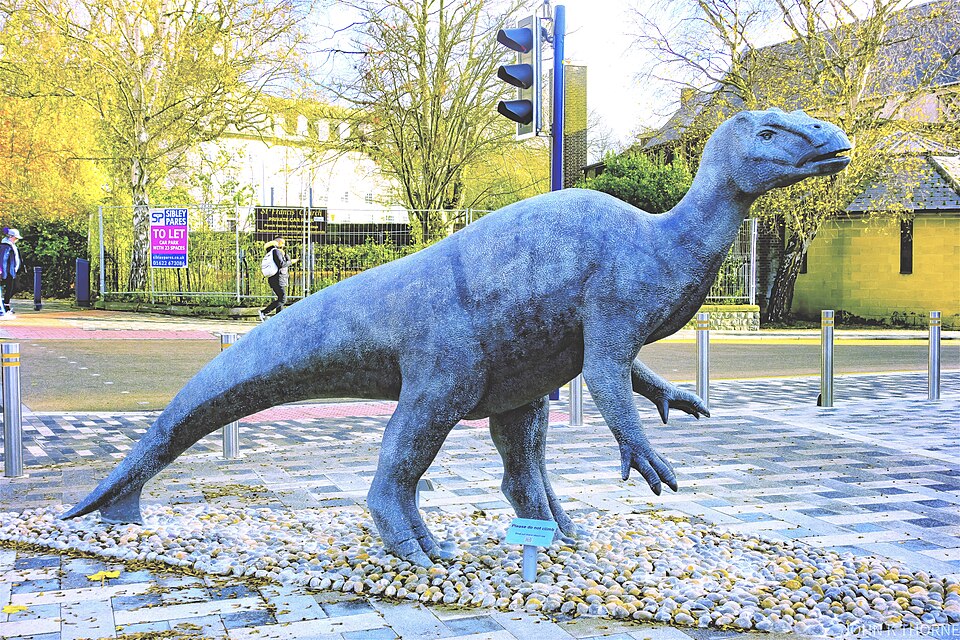
Maidstone’s dinosaur is more than a playful addition to the town’s identity. It commemorates an important fossil discovery made in a local quarry in 1834, when the study of dinosaurs was still taking shape.
The animal traditionally associated with the find is Iguanodon. There is a further detail worth knowing, however: Maidstone Museum now identifies the famous specimen as Mantellisaurus atherfieldensis, following later reclassification.
That combination of discovery and revision makes the story especially interesting. It explains both why a dinosaur appears in Maidstone’s civic imagery and how scientific understanding changes as evidence is studied again.
A discovery in a ragstone quarry
The fossil was found in the Queen’s Road area during quarrying. Quarry owner William Harding Bensted investigated the bones and recorded the discovery through notes and drawings.
The find was not a complete dinosaur standing neatly in rock. It was a partial skeleton preserved in a slab, containing bones that could help researchers understand how the animal fitted together.
Gideon Mantell, a doctor and fossil researcher, recognised its importance. He acquired the specimen, which became closely associated with his work on Iguanodon.
Quarrying and geology therefore meet at the beginning of the story. Material being extracted for ordinary use revealed evidence of an animal from a vastly earlier landscape.
Why the Maidstone specimen mattered
Before articulated remains were available, isolated teeth and bones left considerable uncertainty about the shape of the animals they came from.
The Natural History Museum explains that the Maidstone Slab helped Mantell develop an understanding of Iguanodon’s structure. The relationship between bones offered information that individual fragments could not.
That did not make every early reconstruction correct. Researchers were interpreting unfamiliar animals using incomplete evidence and comparisons with living species.
The value of the discovery lies partly in that process. It contributed to a developing body of knowledge rather than delivering a finished modern picture in a single moment.
The dinosaur that changed shape
Early ideas about Iguanodon differed markedly from later reconstructions. The Natural History Museum’s account describes the significance of subsequent discoveries in changing understanding of the animal.
The familiar thumb spike is a useful example of how interpretation can change. Early reconstructions placed a spike on the nose; later evidence established its association with the hand.
This is not simply a story of an old mistake being replaced by a new illustration. It shows why palaeontologists compare specimens, reconsider assumptions and revise identifications.
For a museum visitor, that makes a reconstruction a statement about the evidence available when it was made, rather than a timeless photograph of an extinct animal.
Iguanodon or Mantellisaurus?
Maidstone Museum’s current collection account says the local fossil was reidentified as Mantellisaurus atherfieldensis.
The historical name remains important because it explains the way the discovery was discussed and celebrated. A reader searching for the “Maidstone Iguanodon” is following a long-established local association.
A careful account can use that familiar name while making the modern identification clear. Otherwise, historical terminology can be mistaken for an unqualified statement about current classification.
The distinction also helps explain why different older labels, books and illustrations may use different names for material associated with Maidstone.
How the fossil became a civic symbol
Maidstone Museum records that the borough council applied in 1946 to add the dinosaur to its coat of arms, and that approval was granted by the Garter Principal King of Arms.
That decision brought a scientific discovery into the town’s public identity. The dinosaur became a way of expressing something distinctive about Maidstone, alongside the more usual heraldic references to people, institutions or geography.
The link can also be seen in the dinosaur sculpture at Maidstone East station. The museum identifies it as a galvanised-steel work by Gary and Thomas Thrussell, commissioned in connection with the station’s refurbishment.
The sculpture is a modern interpretation of that association, rather than a cast of the original fossil.
Where can you learn more?
The original fossil belongs to the Natural History Museum in London. Maidstone Museum’s account identifies a scientific cast and Bensted’s notebook among the material connecting the discovery with the town.
A cast and an original fossil serve different purposes. The cast can show the arrangement of the specimen locally, while the notebook records how a person investigated and documented the discovery.
Check both museums’ current information before travelling specifically to see an object, since display arrangements can change.
The story offers a rewarding starting point for exploring Maidstone’s history: a quarry, a local observer and a fossil researcher became linked through a find that still appears in the town’s symbols.
It also leaves a useful lesson about evidence. Maidstone’s dinosaur matters both because of what people learned in 1834 and because researchers continued to ask new questions afterwards.
Featured photograph: Iggy dinosaur sculpture outside Maidstone East station by John K Thorne, via Wikimedia Commons, CC BY 2.0. Taken 2021-12-01; resized for display. This is an archive photograph.